Thursday, June 19, 2025

Photos: PolGeoNow's 2022 Visit to the Somaliland Office in Taiwan

Important Note: PolGeoNow does not take any position on whether Taiwan or Somaliland should be diplomatically recognized as independent countries, and does not take sides in the disputes they have with the governments of Somalia and China. During our visit to the Somaliland office in Taipei, we made clear to all parties that we were there strictly for neutral journalistic purposes. PolGeoNow has continued to report freely on developments both favorable and unfavorable to the self-declared Somaliland government in the time since our visit.

Photo of the reception room at the Republic of Somaliland Representative Office in Taiwan, taken at its previous location in central Taipei in August 2022. At the center is a wooden armchair with a poster-sized historical map of the former British Somaliland Protectorate mounted behind it. To the left is a matching endtable with only a world globe on it, and to the right there is a freestanding golden plaque engraved with the name of the office in English and traditional Chinese under the Somaliland flag. Behind the plaque is a simple office desk with a miniature Republic of China (Taiwan) flag and a matching miniature flagpole extending to the left, with its flag (if any) obscured by the British Somaliland map.
East Africa's self-proclaimed Republic of Somaliland has an embassy-like representative office in the East Asian city of Taipei, semi-official capital of Taiwan. Somaliland and Taiwan are not accepted as independent countries by the United Nations (UN) - but neither are they controlled by the UN member countries that claim to have authority over them (Somalia and China respectively).

All photos by PolGeoNow

Where is Somaliland in the world? Map approximating the appearance of a globe marking the locations of Taiwan and Somaliland, two "de facto states" or unrecognized independent countries, which established embassy-like offices in each other's capitals in 2020. Taiwan is visible as an island along the rim of East Asia towards the righthand edge of the image, while Somaliland is visible as a small chunk of the eastern Horn of Africa near the image's lefthand side. The bulk of the Asian continent lies between them, with India near the center.
Map modified by PolGeoNow from graphic by Wikimedia user Addicted04 (CC BY-SA)
As part of PolGeoNow's mission to report neutrally on the realities of world geography, we're especially interested in so-called "de facto states" - places that are governed like independent countries, but aren't openly accepted as independent by most other governments. And in August 2022, we were lucky enough to visit an unusual site linking two prominent examples of such unrecognized countries: Somaliland and Taiwan. While in Taipei, Taiwan's semi-official capital, we were invited to visit the representative office of the self-declared Republic of Somaliland, and to meet its head diplomat at the time, Mohamed Hagi.

We reported on our 2022 visit soon afterwards with a thread on Twitter (now X)*, and today we're publishing this more complete account for future reference and historical interest. 

*We're now also active on Mastodon, BlueSky, and Threads 

Somalia Supplement: Did Puntland Declare Independence?

This article is a supplement to PolGeoNow’s series of professional reports on territorial control in Somalia’s decades-long civil war. For more context, see that report series. However, this article is written to be accessible to general audiences.

Puntland's Not-quite "Declaration of Independence" 

Excerpt of 2024 Somalia control map: Puntland state and surrounding areas of Somalia's claimed territory (Somaliland, SSC-Khaatumo), showing both official borders and actual territorial control, including by the so-called Islamic State and Al Qaeda affiliate Al Shabaab in the Cal Miskaad and Cal Madow mountains respectively. Puntland has declared that it's operating as if it were independent, but doesn't consider itself an independent country separate from Somalia.
Part of PolGeoNow's 2024 Somalia control map, showing Puntland state and surroundings. Click on the image to see the full map, complete with detailed legend (free for all readers). The larger blue area on the right represents land solidly controlled by Puntland, while the state's official claimed borders are marked by the dotted while line through Mudug region in the south, and by the left-hand side of the western zone labeled "Area claimed by both Somaliland and Puntland".
As Somalia’s original self-governing state – founded in the chaos of the 1990s before today's Somali federal government even existed – Puntland is in many ways the equivalent of an independent country. Somalia’s federal military has rarely been allowed to operate there, the federal government has little influence over the selection of state or local Puntland officials, and the state government tends to pick and choose to what degree it participates in the federal system. However, unlike neighboring Somaliland, which declared independence in 1991, Puntland has insisted since its founding that it's part of Somalia.

It caught the attention of political geography enthusiasts, then, when in March 2024, Puntland’s government was quoted as saying that it would begin operating with the “full powers of an independent state”. This came amid a dispute over constitutional reforms in Somalia's federal government – a government whose legitimacy Puntland said it no longer recognized. And it’s followed through in practice, refusing to even attend political talks on Somalia’s political future in the year since, continuing its own international relations with countries like the United Arab Emirates (UAE), and fighting a successful war against an important branch of the so-called “Islamic State” (ISIS/ISIL) all on its own (except for some air support from the UAE and US).

Somalia Supplement: Is there an Al Shabaab presence in SSC-Khatumo?

This article is a supplement to PolGeoNow’s series of professional reports on territorial control in Somalia’s decades-long civil war. Reading it should require minimal prior knowledge, but for much more background, see our August 2023 and June 2024 Somalia reports.

Excerpt of 2024 Somalia control map: SSC-Khaatumo (Sool, Sanaag, and Cayn regions) and surrounding areas of Somalia's claimed territory (Somaliland, Puntland), showing actual territorial control and SSC-Khaatumo influence as of June 2024, including Al Qaeda affiliate Al Shabaab's known areas of activity in the nearby Cal Miskaad and Cal Madow mountains. As of 2025, SSC-Khatumo is recognized as a federal state of Somalia by the national government in Mogadishu, though the legal processes to formally make it into one haven't so far been completed.
Part of PolGeoNow's 2024 Somalia control map, showing areas of control and influence by SSC-Khatumo as the smaller area of blue on the left, and areas solidly controlled by Somaliland in green. Click on the image to see the full map, complete with detailed legend (free for all readers). Areas of known Al Shabaab presence are shown in the north, outside SSC-Khatumo's are of influence.

In 2023, militias in the northern area of Somalia’s claimed territory rose up in rebellion against the self-declared Republic of Somaliland, which has claimed since 1991 to be a separate country from Somalia. These militias and their supporters are trying to instead join Somalia as one of its federal states, which they call “SSC-Khatumo” (SSC-Khaatumo in Somali). The “SSC” stands for the three regions they claim governance over: Sool, Sanaag, and “Ayn” (spelled Cayn in Somali, though to most English speakers the C sounds silent).

As part of Somaliland’s opposition to SSC-Khatumo, various allegations have been made that the insurrectionists are linked to Al Shabaab, the Al Qaeda affiliated organization that governs much of rural southern Somalia. These clams have been largely ignored outside of Somaliland, but we’re still sometimes asked why our maps don’t appear to take them into account. To address this, we’ve written up this article to explain in detail what’s going on, what we know about it, and what the reasoning is behind our mapping of the situation.

Saturday, January 11, 2025

Syria: Map of Control in January 2025 (Subscription)

SUBSCRIBERS CLICK HERE TO VIEW FULL ARTICLE AND MAP:
Old Portal (members.polgeonow.com) | New Portal (controlmaps.polgeonow.com)


There are newer editions of this map available. To see them, view all Syria updates.

Research by Djordje Djukic. Map by onestopmap.com, Evan Centanni, and Djordje Djukic
Subscribe for full access to all conflict map reports!

Thumbnail preview of Syrian Civil War map: Territorial control in Syria on January 9, 2025, a month after the collapse of the Assad government (Hayat Tahrir al-Sham (HTS / Al-Nusra Front), Free Syrian Army and Syrian National Army rebels backed by Türkiye (Turkey), Kurdish YPG, Syrian Democratic Forces (SDF), Israeli military (IDF), remaining Russian bases, and area controlled by Druze militias of uncertain alignment). Includes areas of major known activity for so-called Islamic State (ISIS/ISIL), Turkish presence, and US deconfliction zone, plus recent locations of conflict and other events, including Dayr Hafir (Deir Hafir), the Tishrin Dam, Suwayda, Hmeimim (Khmeimim) airbase, Russia's Tartus naval base, and more.A month after the fall of Assad, much is still unresolved. Russian bases remain along the coast, and Kurdish-led forces operate their own government in the east, where their war with Turkish-backed former rebels continues after a failed ceasefire. 

Meanwhile, Israel has further expanded its control in the southwest, while the so-called "Islamic State" (ISIS/ISIL) reportedly grows in power, and Suwayda province is controlled by Druze militias with an unclear stance towards the new rebel-installed national government.

See all this and more on the latest update to PolGeoNow's concise, professional Syrian Civil War control map, which includes a timeline of key events since our previous Syria map report illustrating the situation on December 14, with sources cited.

This map and report are premium content, available to paid subscribers of the PolGeoNow Conflict Mapping Service.

Want to see before you subscribe? Check out our most recent FREE SAMPLE Syria map!

Exclusive map report includes:

  • Up-to-date illustration of current territorial control in Syria, color-coded for the victorious rebel coalition, the Kurdish-led Syrian Democratic Forces (SDF), resurgent forces of the so-called "Islamic State" (ISIS/ISIL), the Israeli military (IDF), and other non-rebel-allied forces like the Russian military and Druze militias.
  • Pattern showing the major areas of "Islamic State" (ISIS/ISIL) activity beyond what the group fully controls.
  • Special symbol for joint Turkish/rebel control in the border region
  • Outline showing approximate location of the US-declared "deconfliction zone"
  • Special symbols indicating which towns and cities are under the rebel bloc led by Hayat Tahrir al-Sham (HTS) - formerly the Al Qaeda-affiliated Nusra Front - and by the Kurdish YPG militia (part of the SDF anti-"Islamic State" coalition)
  • Detailed indication of city-by-city control, including key towns and other locations important to current events
  • Locations of recent control changes and other important events, including Dayr Hafir, the Tishrin Dam, Suwayda, Hmeimim (Khmeimim) airbase, Russia's Tartus naval base, and more
  • Detailed timeline of important events and changes to territorial control since December 14, 2024, with links to sources.

SUBSCRIBERS CLICK HERE TO VIEW FULL ARTICLE AND MAP:
Old Portal (members.polgeonow.com) | New Portal (controlmaps.polgeonow.com)


Not signed up yet? Click here to learn more about our professional subscription service!

Can I purchase just this map?
This map and report are not available for automated purchase to non-subscribers. If you need access or republication rights for only this map report, contact service@polgeonow.com for options.

Tuesday, January 7, 2025

How Many Countries Were There in the World in 2025?

There are newer editions of this article available. To find the most recent, view all "How Many Countries in the World" updates!    

This article, originally from 2011, has been revised and updated to January 2025. You can view older versions of the article in our archives. No changes have been made to the country counts in this article since last year's update.

How many countries: map of the world
A world political map published by the US government.

One of the most basic questions for map-lovers is "How many countries are there in the world?" But anyone who just gives you a simple number isn't telling the whole truth. It actually depends a lot on how you define a "country". Here are six of the most common answers, each correct in its own way:

Friday, December 20, 2024

Syria: Map of Control After the Fall of Assad - Dec. 14, 2024 (Subscription)

SUBSCRIBERS CLICK HERE TO VIEW FULL ARTICLE AND MAP:
Old Portal (members.polgeonow.com) | New Portal (controlmaps.polgeonow.com)


There are newer editions of this map available. To see them, view all Syria updates.

Research by Djordje Djukic, with additional reporting by Evan Centanni. Map by onestopmap.com, Evan Centanni, and Djordje Djukic

Subscribe for full access to all conflict map reports!

Thumbnail preview of Syrian Civil War map: Territorial control in Syria on December 14, 2024, almost a week after the final collapse of the Assad government (Hayat Tahrir al-Sham (HTS / Al-Nusra Front), Free Syrian Army and Syrian National Army rebels backed by Türkiye (Turkey), Kurdish YPG, Syrian Democratic Forces (SDF), Israeli military (IDF), and remaining Russian bases). Includes areas of major known activity for so-called Islamic State (ISIS/ISIL), Turkish presence, and US deconfliction zone, plus recent locations of conflict and other events, including Manbij, Tanf, Al-Kawm, Hmeimim (Khmeimim) airbase, Russia's Tartus naval base, Al-Ba'ath, and more.As the Syrian government collapsed, rebel forces spread out to assert themselves as the new authorities across most of the country, though much remains to be settled. Turkish-backed rebels jockeyed with the Kurdish-led SDF for control of the north and east, while Israel sent troops towards Damascus and the so-called "Islamic State" (ISIS/ISIL) attempted a resurgence in the central desert.

See all this and more on the latest update to PolGeoNow's concise, professional Syrian Civil War control map, which includes a timeline of key events since our previous Syria map report illustrating the situation eight days earlier, with sources cited.

This map and report are premium content, available to paid subscribers of the PolGeoNow Conflict Mapping Service.

Want to see before you subscribe? Check out our most recent FREE SAMPLE Syria map!

Exclusive map report includes:

  • Up-to-date illustration of current territorial control in Syria, color-coded for the victorious rebel coalition, the Kurdish-led Syrian Democratic Forces (SDF), resurgent forces of the so-called "Islamic State" (ISIS/ISIL), the Israeli military, and the two remaining Russian military bases in the country.
  • Pattern showing the major areas of "Islamic State" (ISIS/ISIL) activity beyond what the group fully controls.
  • Special symbol for joint Turkish/rebel control in the border region
  • Outline showing approximate location of the US-declared "deconfliction zone"
  • Special symbols indicating towns dominated by the rebels of Hayat Tahrir al-Sham (HTS) - formerly the Al Qaeda-affiliated Nusra Front - and by the Kurdish YPG militia (part of the SDF anti-"Islamic State" coalition)
  • Detailed indication of city-by-city control, including key towns and other locations important to current events
  • Locations of recent control changes and other important events, including Manbij, Tanf, Al Kawm, Hmeimim (Khmeimim) airbase, Russia's Tartus naval base, Al-Ba'ath, and more
  • Detailed timeline of important events and changes to territorial control since December 6, 2024, with links to sources.

SUBSCRIBERS CLICK HERE TO VIEW FULL ARTICLE AND MAP:
Old Portal (members.polgeonow.com) | New Portal (controlmaps.polgeonow.com)


Not signed up yet? Click here to learn more about our professional subscription service!

Can I purchase just this map?
This map and report are not available for automated purchase to non-subscribers. If you need access or republication rights for only this map report, contact service@polgeonow.com for options.

Monday, December 9, 2024

Syrian Civil War Reignites: Map of Control Amid Rebel Advance (Dec. 6, 2024)

This map shows the situation on December 6, 2024, just before the final collapse of the Bashar al-Assad government in Damascus. Though the cities of Homs and Damascus have reportedly come under rebel control since then, the country is now in such disarray that current control can't be accurately mapped. 

We plan to publish an update for our subscribers within the next few days, clarifying post-Assad control once the dust has begun to settle.

There are newer editions of this map available. To see them, view all Syria updates.

Syrian Civil War map: Territorial control in Syria on December 6, 2024, ten days into the surprise rebel offensive, and just before their advance led to a full collapse of the Assad government (Free Syrian Army rebels, Kurdish YPG, Syrian Democratic Forces (SDF), Hayat Tahrir al-Sham (HTS / Al-Nusra Front), and others). Includes areas of major known activity for so-called Islamic State (ISIS/ISIL), Turkish/SNA control, joint SDF-Assad control, and US deconfliction zone, plus recent locations of conflict, including Aleppo, Hama, Daraa, Deir ez-Zor, and more. Colorblind accessible.
Base map by Koen Adams of onestopmap.com, with territorial control by Djordje Djukic and Evan Centanni. Area of IS activity is based on 2024 data from ACLED (see footnote for full citation), and reflects a change in methodology from previous editions.
Contact us for permission to use this map.

Timeline by Djordje Djukic

Return to War: Lightning Offensive and Countrywide Shifts

Twelve days ago, Syria's 13-year-old civil war, mostly dormant for the past four years, exploded back onto the scene with a surprise rebel offensive out of the northwest, which quickly managed to seize the country's second largest city, Aleppo. The lead rebel group was the former Al Qaeda affiliate Hayat Tahrir al-Sham (HTS), though Turkish-backed rebels from the northern border regions also joined the fray, with the two groups quickly taking over the country's second largest city, Aleppo. 

As hardline HTS-led forces marched rapidly south, two more rebel fronts emerged, with US-backed fighters in the southern desert expanding out of their longtime safe zone, and a reborn opposition in the southwest recapturing the former rebel stronghold of Daraa. Meanwhile, the Kurdish-led Syrian Democratic Forces (SDF) moved to consolidate their control in the north and east, and over the next ten days moved into areas west of the Euphrates River - including the major city of Deir ez-Zor - as the Syrian military withdrew.

December 6th - the date illustrated on the map above - saw the Syrian military's last major resistance to the surprise rebel assault. The next two days would be a period of government free fall, with rebels apparently entering the city of Homs and national capital Damascus without much resistance. Meanwhile, authoritarian president Bashar al-Assad fled the country as his military withdrew from both cities and the country's central desert, conceding victory in the central conflict of the country's 13-year civil war.

Assad Has Fallen: What's Next for Control in Syria?

Syria is now in disarray, and many questions remain to be answered. What kind of new government will emerge in Damascus? Will former government loyalists hold onto the country's now-isolated coastal region, a traditional bastion of Assad's supporters and still host to his Russian military allies? Will democracy-minded rebel groups work together with the religious-hardline HTS, turn against it, or go their own way in their own strongholds? 

One thing that does seem certain: Syria's division isn't over yet. Even if a rebel coalition government secures power over the country's whole west and center, much of the north and northeast remain under control of the Kurdish-led SDF. While the SDF and the provisional government of its controlled areas do still consider themselves part of Syria, they'll likely be in no hurry to submit to any rebel-led administration. For one thing, they're determined to guarantee rights for Syria's Kurdish people before any future reintegration - and likely under pressure from its US patrons to continue the fight against the so-called "Islamic State" (IS, formerly ISIS).

But the Kurdish-led forces in the northeast also aren't on good terms with either of the two most powerful rebel factions. With Türkiye's government labeling the Kurdish militias at the core of the SDF's forces as terrorist groups, Turkish-backed rebels are more enemies than friends to the US-backed coalition (despite the US and Türkiye being allied with each other as fellow NATO members). Meanwhile, it probably goes without saying that the pro-democracy, fiercely anti-IS, US-supported SDF will be wary of cooperation with the religious-hardline HTS, who many fear could become the next Taliban.

To follow our further coverage as post-Assad territorial control develops, visit or bookmark our listing of all Syria control map reports.

Sunday, December 1, 2024

Ukraine: Map of Russian Control in February 2024 (Subscription)

SUBSCRIBERS CLICK HERE TO VIEW FULL ARTICLE AND MAP:
Old Portal (members.polgeonow.com) | New Portal (controlmaps.polgeonow.com)

(To see other maps in this series, view all Ukraine articles on PolGeoNow.) Hidden image for crawlers

Research by Djordje Djukic. Map by Evan Centanni and Djordje Djukic

Subscribe for full access to all conflict map reports!

Thumbnail previewing map of Russian-controlled territory in Ukraine on Februaryy 19, 2024. In addition to the Crimean peninsula, which Russia had already seized in 2014, and parts of the far eastern Donetsk and Luhansk provinces (the Donbas region) already controlled by Russia-backed separatist rebels (and formerly declared independent as the Donetsk and Lugansk People's Republics), Russian forces still controlled a wide belt of territory just north of Crimea, including large parts of Kherson and Zaporizhzhia provinces, as well as large additional areas of Donetsk and Luhansk provinces. Meanwhile, all of those provinces are now claimed by the Russian government as parts of Russia, creating a new claimed international border through what was until recently undisputed eastern Ukraine. This map shows the situation at the end of the Battle of Avdiivka, when Russia captured that Ukrainian stronghold town. Map includes key locations from the news, such as Adviivka, Marinka, Synkivka, Pischane, Krynky, and more. Colorblind accessible.

Late 2023 and early 2024 saw small but steady gains by Russian forces across eastern Ukraine, capped by the milestone capture of Ukrainian stronghold town Avdiivka near Donetsk city. This shift in favor of Russia heralded the end of Ukraine's much-hyped 2023 counter-offensive, which had achieved disappointingly modest results.

(The maps in this report show the situation as of February 19, 2024. Territorial changes since that time, including Ukraine's surprise incursion into Russia, will be covered in a future report.)

See all this and more on the latest update to PolGeoNow's concise, professional Ukraine war control map, which includes a detailed chronicle of changes and events since our previous Ukraine map report illustrating the situation in October 2023, with sources cited, as well as a close-up map of control within the claimed borders of the Donetsk and Lugansk People's Republics (which now claim to be self-governing regions inside Russia).

This map and report are premium content, available to paid subscribers of the PolGeoNow Conflict Mapping Service.

Want to see before you subscribe? Check out our most recent FREE SAMPLE Ukraine map!

Exclusive map report includes:

  • Illustration of current territorial control in Ukraine in February 2024, color-coded for the Ukrainian government on one side and the Russian military and allied forces on the other side, with areas of uncertainty indicated. Colorblind accessible.
  • Darker color indicating which areas were already under Russian or allied control before the 2022 invasion began
  • Lines showing Russia's claimed border after its annexations of Donetsk, Luhansk, Zaporizhzhia, and Kherson provinces.
  • Preview thumbnail of map of territorial control within the claimed borders of the self-declared Donetsk People's Republic (DPR) and Lugansk People's Republic (LPR), which now consider themselves part of Russia, updated to February 19, 2024. Map shows that the vast majority of the LPR, otherwise known as Ukraine's Luhansk province, is now under the control of Russia, while Russian forces also control over half of the DPR, or Ukraine's Donetsk province, including the major central and southern cities of Donetsk, Horlivka, Makiyivka, and Mariupol. Includes key locations from the news, such as Avdiivka, Marinka, Terny, Yakovlivka, Novomykhailivka, and many more. Colorblind accessible.
    Donbas close-up map
    Close-up map of territorial control within the self-proclaimed boundaries of the Donetsk People's Republic and Lugansk People's Republic, which now claim to be part of Russia
  • Detailed indication of city-by-city control, including key towns and other locations important to current events
  • Locations of recent control changes and other important events, including Avdiivka, Marinka, Krynky, Terny, Pischane, Novomykhailivka, and more
  • Detailed timeline of important events and changes to territorial control from October 9, 2023 to February 19, 2024, with links to sources.

SUBSCRIBERS CLICK HERE TO VIEW FULL ARTICLE AND MAP:
Old Portal (members.polgeonow.com) | New Portal (controlmaps.polgeonow.com)


Not signed up yet? Click here to learn more about our professional subscription service!

Can I purchase just this map?
This map and report are not available for automated purchase to non-subscribers. If you need access or republication rights for only this map report, contact service@polgeonow.com for options.

Sunday, October 6, 2024

Israel / Palestine: Map of Control at Start of Lebanon Incursion - Oct. 6, 2024 (Subscription)

SUBSCRIBERS CLICK HERE TO VIEW FULL ARTICLE AND MAP:
Old Portal (members.polgeonow.com) | New Portal (controlmaps.polgeonow.com)


(To see more maps in this series, view all Israel articles or Palestine articles on PolGeoNow.)

Map by Evan Centanni, timeline by Djordje Djukic with Evan Centanni

Subscribe for full access to all conflict map reports!

Thumbnail preview of map of who controlled Palestine and Israel's claimed territories on October 6, 2024, soon after the beginning of Israel's ground incursion into Lebanon. Shows both Israeli and Palestinian Authority administration (Fatah and Hamas factions indicated separately). Includes bigger West Bank map (Area A, Area B, and Area C). Map also includes Gaza Strip, Golan Heights, major cities and Israeli settlements, UN peacekeeper deployments (UNIFIL in Lebanon and UNDOF in Syria), no man's land, Golan Heights buffer zone (area of separation, AOS), and Shebaa Farms. Also shows which areas of Israel proper are under the greatest military restrictions, including the so-called Gaza Envelope and Confrontation Line zones as well as much of northern Israel. Includes all major cities and various key towns and sites from the news, like Khan Yunis, Nevatim airbase, Hatzerim and Tel Nof airbases, Jabalia, Yaroun, Adeissah, Jenin, Tulkarm, Tubas, and more, as well as the so-called Philadelphi Corridor and Netzarim Corridor in the Gaza Strip. Colorblind accessible.

What some once called the "Gaza War" is now unquestionably something much bigger, with Israel directing much of its military force instead across the Lebanon border at the Hezbollah militia, assassinating enemies across the middle east, and coming under major direct attack from Iran. Ground fighting in the Gaza Strip has eased, but Israeli airstrikes continue, and Israeli military actions have intensified in the West Bank.

See all this and more in the latest update to PolGeoNow's widely-acclaimed map of territorial administration in the Israel/Palestine area. In addition to the updated map, the report also includes a detailed chronicle of changes and events since June 27, 2024, the date illustrated by our previous Israel/Palestine control map.

This map and report are premium content, available to paid subscribers of the PolGeoNow Conflict Mapping Service.

Want to see before you subscribe? Check out our most recent FREE SAMPLE Israel/Palestine map report!

Exclusive map report includes:

  • Up-to-date illustration of current territorial control across all areas claimed by either Israel or Palestine, including Hamas and Israeli military control in the Gaza Strip (not in extreme detail), as well as UN peacekeeper deployments just outside the region
  • Closer-up inset map showing the divisions in the West Bank: Israeli military control ("Area C", including Israeli settlements), Fatah-led Palestinian jurisdiction ("Area A"), zones of shared administration ("Area B"), and the (annexed) area of Israeli civilian control in East Jerusalem
  • Lines illustrating the pre-1967 ceasefire boundaries separating Israel proper from the Palestinian-claimed Gaza Strip and West Bank, as well as the Syria-claimed Golan Heights
  • Labels for contentious areas, like the Gaza Strip, West Bank, Golan Heights, Shebaa Farms, and "no man's land"
  • Illustration of which parts of Israel proper are subject to the greatest restrictions by military decree under current war powers: the "Gaza Envelope" in the south and the "Confrontation Line" in the north, and now much of northern Israel and the Golan Heights.
  • Detailed indication of city-by-city control, including key towns and other locations important to current events, including in the West Bank and contested towns across the border in Lebanon
  • Locations of recent control changes and other important events, including Khan Yunis, Nevatim airbase, Hatzerim and Tel Nof airbases, Jabalia, Yaroun, Adeissah, Jenin, Tulkarm, Tubas, and more, as well as the so-called Philadelphi Corridor and Netzarim Corridor in the Gaza Strip
  • Detailed timeline of important events and changes to territorial control since June 27, 2024, with links to sources.
  • Additional timeline entries chronicling events in all four additional fronts to the conflict: (1) the Lebanon border, where Israel and Hezbollah are engaged in cross-border strikes and now an Israeli ground incursion; (2) the West Bank, where near-daily Israeli raids on Palestinian-governed cities have have recently become more intense and destructive; (3) attacks on Western shipping in the Red Sea and Gulf of Aden near Yemen, where the US and UK have retaliated militarily against the Yemeni "Houthi" government; and (4) increasing related violence across the Middle East, including direct Iranian and Houthi attacks on Israel; Israeli airstrikes and assassinations in Lebanon, Syria, and Iran; and resumed Iran-backed militia attacks on US forces in Iraq and Syria (Fronts 3 and 4 are not illustrated on the map).

SUBSCRIBERS CLICK HERE TO VIEW FULL ARTICLE AND MAP:
Old Portal (members.polgeonow.com) | New Portal (controlmaps.polgeonow.com)


Not signed up yet? Click here to learn more about our professional subscription service!

Can I purchase just this map?
This map and report are not available for automated purchase to non-subscribers. If you need access or republication rights for only this map report, contact service@polgeonow.com for options.

Tuesday, July 23, 2024

Parade of Nations: Which Countries Are (and Aren't) in the Olympics? (Paris 2024)

2026 Update: As the Milano Cortina 2026 Winter Olympics prepare to officially open, we don't so far have an updated version of our explainer on which countries and are and aren't in the Olympics. However, the below update from the Paris 2024 summer Olympics is still accurate as far as which countries are and aren't accepted as Olympic nations. Details on suspended countries may or may not be out-of-date, and the list of current attendees is different (you can see it on Wikipedia).

This is an updated version of an article first published in 2012. To see previous versions, view all Olympics articles on PolGeoNow.


World map showing the five continental associations of National Olympic Committees, including all nations eligible for the Beijing 2022 Olympic Games.
Map of all countries in the Olympics and their regional associations. By Evan Centanni, modeled after this map.


The 2024 Summer Olympics are officially opening this Friday, July 26. This year they're officially hosted by the city of Paris, France, though events will be held all around the country. This is the sixth time France has hosted the games (including the Winter Olympics). It's also Paris's third time to host the Olympics, though it took a break for 100 years. The only other city to host three times is London, in the UK.

Of course, it wouldn't be an Olympic opening ceremony without the Parade of Nations. But how many countries are there in the games, and is everyone included? Read on for PolGeoNow's updated guide to the roster of Olympic Nations...

How Many Countries Were There in the World in 2024?

There are newer editions of this article available. To find the most recent, view all "How Many Countries in the World" updates!   

This article, originally from 2011, has been revised and updated to July 2024. You can view older versions of the article in our archives. The main update from last year is the surrender of the self-proclaimed Artsakh Republic (Nagorno-Karabakh), whose territory is now controlled by Azerbaijan.

How many countries: map of the world
A world political map published by the US government.

One of the most basic questions for map-lovers is "How many countries are there in the world?" But anyone who just gives you a simple number isn't telling the whole truth. It actually depends a lot on how you define a "country". Here are six of the most common answers, each correct in its own way:

Saturday, June 29, 2024

Israel / Palestine: Map of Control Amid Rafah Offensive - June 27, 2024 (Subscription)

SUBSCRIBERS CLICK HERE TO VIEW FULL ARTICLE AND MAP:
Old Portal (members.polgeonow.com) | New Portal (controlmaps.polgeonow.com)


There are newer editions of this map available. To see them, view all Israel articles or Palestine articles on PolGeoNow.

Map by Evan Centanni, timeline by Djordje Djukic with Evan Centanni

Subscribe for full access to all conflict map reports!

Thumbnail preview of map of who controlled Palestine and Israel's claimed territories on June 27, 2024, during the so-called Rafah offensive. Shows both Israeli and Palestinian Authority administration (Fatah and Hamas factions indicated separately). Includes bigger West Bank map (Area A, Area B, and Area C). Map also includes Gaza Strip, Golan Heights, major cities and Israeli settlements, UN peacekeeper deployments (UNIFIL in Lebanon and UNDOF in Syria), no man's land, Golan Heights buffer zone (area of separation, AOS), and Shebaa Farms. New edition also shows so-called Gaza Envelope and Confrontation Line zones, the areas of Israel proper are under the greatest military restrictions. Includes all major cities and various key towns and sites from the news, like Rafah, Nuseirat Refugee Camp, the US floating pier (humanitarian aid pier), Mount Meron, Hebbariye, Jenin, Tulkarm, and more. Now with improved colorblind accessibility.

Over the last four months, Israel first withdrew most its forces from the Gaza Strip, soon sent them back into certain areas, then began a scaled-down version of its long-promised Rafah offensive. Its forces now hold part of Rafah and other specific areas, while the UN says there's “no authority in most of the territory”. 

Meanwhile, related violence has continued along the Lebanon border, in the West Bank, and in the Red Sea, with broader Middle East tensions reaching a peak in mid-April with a direct exchange of fire between Israel and Iran.

See all this and more in the latest update to PolGeoNow's widely-acclaimed map of territorial administration in the Israel/Palestine area. In addition to the updated map, the report also includes a detailed chronicle of changes and events since March 4, 2024, the date illustrated by our previous Israel/Palestine control map.

This map and report are premium content, available to paid subscribers of the PolGeoNow Conflict Mapping Service.

Want to see before you subscribe? Check out our most recent FREE SAMPLE Israel/Palestine map report!

Exclusive map report includes:

  • Up-to-date illustration of current territorial control across all areas claimed by either Israel or Palestine, including Hamas and Israeli military control in the Gaza Strip (not in extreme detail), as well as UN peacekeeper deployments just outside the region
  • Closer-up inset map showing the divisions in the West Bank: Israeli military control ("Area C", including Israeli settlements), Fatah-led Palestinian jurisdiction ("Area A"), zones of shared administration ("Area B"), and the (annexed) area of Israeli civilian control in East Jerusalem
  • Lines illustrating the pre-1967 ceasefire boundaries separating Israel proper from the Palestinian-claimed Gaza Strip and West Bank, as well as the Syria-claimed Golan Heights
  • Labels for contentious areas, like the Gaza Strip, West Bank, Golan Heights, Shebaa Farms, and "no man's land"
  • Illustration of which parts of Israel proper are subject to the greatest restrictions by military decree under current war powers: the "Gaza Envelope" in the south and the "Confrontation Line" in the north, as well as known closed areas of the Golan Heights
  • Detailed indication of city-by-city control, including key towns and other locations important to current events, including in the West Bank and along the border with Israel and Lebanon
  • Locations of recent control changes and other important events, including Rafah, Nuseirat Refugee Camp, the US floating humanitarian pier, Mt. Meron, Hebbariye, Jenin, Tulkarm, and more
  • Detailed timeline of important events and changes to territorial control since March 4, 2024, with links to sources.
  • Additional timeline entries chronicling events in all four additional fronts to the conflict: (1) the Lebanon border, where Israel and Hezbollah are engaged in cross-border strikes; (2) the West Bank, where near-daily Israeli raids on Palestinian-governed cities have led to intense clashes; (3) attacks on Western shipping in the Red Sea and Gulf of Aden near Yemen, where the US and UK have retaliated militarily against the Yemeni "Houthi" government; and (4) the recent flare-up of direct violence between Israeli and Iran, including Israeli strikes on Iran-aligned targets in Syria (Fronts 3 and 4 are not illustrated on the map).

SUBSCRIBERS CLICK HERE TO VIEW FULL ARTICLE AND MAP:
Old Portal (members.polgeonow.com) | New Portal (controlmaps.polgeonow.com)


Not signed up yet? Click here to learn more about our professional subscription service!

Can I purchase just this map?
This map and report are not available for automated purchase to non-subscribers. If you need access or republication rights for only this map report, contact service@polgeonow.com for options.

Tuesday, June 11, 2024

Sudan Control Map & Timeline: Former Rebels Join Fight - June 2024

Hidden image for crawlers(To see other maps in this series, view all Sudan articles on PolGeoNow.)

This marks the first fully up-to-date edition of our new Sudan map series, after several retrospective reports on the situations in previous months. The latest of those, featuring a map of control at the end of January 2024, is being published alongside this one. 

To access our full catalog of map reports covering control in Sudan and many other countries, sign up for our Control Map Subscription Service - popular with major government and international organizations, but available to individual subscribers at just US$19.99 per month!

Sudan War: Map of who controlled what in Sudan on June 11, 2024, showing the situation after most of Darfur's former rebel Joint Force joined the fight alongside the army. Best Sudan control map online, thoroughly researched for maximum accuracy. Shows territorial control by the government-affiliated Sudanese Armed Forces (SAF), the Rapid Support Forces (RSF) paramilitary, and rebel groups in Sudan including the Sudan Liberation Army/Movement's Abdelwahid El Nur faction (SLA-AW/SLM-AW) in Darfur's Jebel Marra, the SPLM-N faction of Abdelaziz El Hilu in the Two Areas of South Kordofan (Nuba Mountains) and Blue Nile. Also shows the area of control of the Ngok Dinka Abyei Area Administration (AAA) within the disputed Abyei Box, and the known bases and area of operation of the remaining Neutral Joint Force of former rebels in Darfur who haven't taken sides. Includes disputed territories claimed by other countries, including the Halaib Triangle, Bir Tawil, and Wadi Halfa Salient along the border with Egypt, plus Kafia Kingi, 14-mile, Abyei, Heglig (Hejlij), Kaka, and Bebnis along the South Sudan border, showing which parts are controlled by which country. Includes key towns and other locations from the news, including the Sennar Sugar Factory, Omdurman, Bahri, El Fau (Al Fao), Jebel Dayir, Delling (Dilling, Dalang), Zurrug, Mellit, Korma, Ayn Siro, Tina border crossing, Misteriya, Al Dabbah (El Debba), Babanusa, Lagawa (Laqawa), Um Rawaba and many more.
Map by Evan Centanni and Djordje Djukic, starting from base map by Koen Adams of onestopmap.com. "Neutral Joint Force" has been redefined to exclude Darfuri former rebel groups who have joined the fight against the RSF, now subsumed under "Govt./SAF & allies". See below for a detailed accounting of which groups are included in each territorial control category. To use this map in your own materials, please contact us to arrange permission.

Timeline by Djordje Djukic and Evan Centanni

Darfur's Joint Force Enters War Against RSF, Kicking off Battle of El Fasher

In the four months since the date depicted on PolGeoNow's previous Sudan control map, lines of control have remained mostly stable, except for a major SAF breakthrough within the city of Omdurman and the RSF's takeover of Mellit, the headquarters of Darfur's Joint Force coalition. Other changes to the map have been made to show where new evidence has emerged of RSF presence (or lack thereof), but these don't represent major victories or defeats. The bigger story has, instead, been a critical realignment in alliances.

The leaders of Darfur's most prominent "Joint Force" former rebel groups, the SLM-MM and JEM-Jibril, have been outspoken against the RSF since November 2023, even recruiting and training new SAF-allied forces in eastern Sudan. But until recently, their field commanders based in Darfur, where the core of each group's forces were stationed, had kept unofficially neutral in the war, helping preserve a year-long, citizen-mediated ceasefire in the city of El Fasher. That all changed after Joint Force troops started fighting alongside the SAF around Khartoum in late March, leading to RSF retaliation across Sudan. By mid-April, the group's major commanders in Darfur had joined the fight, kicking off a devastating, full-scale battle for the region's capital.

A few months ago, "neutral Joint Force" was a useful label for most of the former rebel forces in Darfur, but today it can only fairly apply to the minority of factions who refused to enter the battle, and now say they're launching an official "Neutral Joint Force" separate from the larger SAF-allied one. Our map has been changed accordingly, now subsuming SAF-allied groups within "Govt./SAF and allies", while reserving the "Neutral Joint Force" symbols from the January map for the new strictly neutral coalition. Nearly every Darfuri former rebel group has split into factions over the question of whether to ally with the SAF (the longtime leaders of the SLM-TC and GSLF, alongside their loyalist factions, head the neutral camp).

Sudan Control Map & Timeline: RSF Takes Eastern City - Jan. 2024 (Subscription)

Hidden image for crawlersSUBSCRIBERS CLICK HERE TO VIEW FULL ARTICLE AND MAP:
Old Portal (members.polgeonow.com) | New Portal (controlmaps.polgeonow.com)


There are newer editions of this map available. To see them, view all Sudan articles on PolGeoNow.

Map and article by Evan Centanni and Djordje Djukic

Subscribe for full access to all conflict map reports!

(Thumbnail preview) Sudan War: Map of who controlled what in Sudan on January 31, 2024, showing the situation after the RSF takeover of Wad Medani and most of Gezira (Jazira) state. Best Sudan control map online, thoroughly researched for maximum accuracy. Shows territorial control by the government-affiliated Sudanese Armed Forces (SAF), the Rapid Support Forces (RSF) paramilitary, and rebel groups in Sudan including the Sudan Liberation Army/Movement's Abdelwahid El Nur faction (SLA-AW/SLM-AW) in Darfur's Jebel Marra, the SPLM-N faction of Abdelaziz El Hilu in the Two Areas of South Kordofan (Nuba Mountains) and Blue Nile. Also shows the area of control of the Ngok Dinka Abyei Area Administration (AAA) within the disputed Abyei Box, and the general area of presence and major bases of the neutral Joint Force of Darfur former rebel groups. Includes disputed territories claimed by other countries, including the Halaib Triangle, Bir Tawil, and Wadi Halfa Salient along the border with Egypt, plus Kafia Kingi, 14-mile, Abyei, Heglig, Kaka, and Bebnis (Babnis) along the South Sudan border, showing which parts are controlled by which country. Includes key towns and other locations from the news, including Sennar, El Giteina (Gitaina), Al Hasaheisa, Rufaa, Bara, Habila, Nertiti, Umbro (Umm Baru), Tina border crossing, Shendi, Jebel Moon, Babanusa, Um Rawaba and many more.

In December 2024, Sudan's defiant Rapid Support Forces (RSF) paramilitary made waves by invading new parts of Sudan's eastern heartland, capturing the major city of Wad Medani and most of Gezira (Al-Jazirah) state. Meanwhile, a new battle was brewing in Darfur as tensions reached a peak in El Fasher, where our map now shows areas of control and presence for the neutral former rebel groups of the Joint Force.

(This edition of our new Sudan map series depicts control at the end of January 2024 based on research conducted through mid-June.)

See all this and more in the latest update to PolGeoNow's rigorously-researched and exhaustively cited Sudan control map and report - the most precise and accurate available online. Besides the updated map, the report also includes a brief who's-who of Sudan's rebel and former rebel groups, plus a detailed chronicle of changes and events since December 5, 2023, the date illustrated by our previous Sudan control map.

This map and report are premium content, available to paid subscribers of the PolGeoNow Control Maps Subscription Service.

Want to see before you subscribe? Check out our most recent FREE SAMPLE Sudan map report!

Exclusive map report includes:

  • Up-to-date illustration of current territorial control in Sudan's new civil war between the Sudanese Armed Forces (official government military) and Rapid Support Forces (RSF) paramilitary group, rigorously corroborated, with areas of ambiguity clearly indicated. 
  • Detailed and carefully-researched illustration of territorial control by Sudan's two major "holdout" rebel forces from before the 2023 war: SPLM-N El Hilu in South Kordofan and Blue Nile states, and the SLM-AW (SLA-AW) in Darfur's Jebel Marra. 
  • NEW: Indication of power centers and area of presence for Darfur's neutral Joint Force of former rebel groups
  • Brief who's-who guide to all the major groups and factions among Sudan's rebels and former rebels
  • Detailed explanation of what each color represents on the map, and which forces are included as "allies" of each side
  • Thoroughly-researched depictions of each disputed territory claimed by Sudan along the Egyptian and South Sudanese borders, marking which parts are controlled by the other countries and which parts by other groups (e.g. UN peacekeepers and the Ngok Dinka "Abyei Area Administration").
  • Detailed indication of city-by-city control, including key towns and other locations important to current events
  • Locations of recent control changes and other important events, including El Giteina (Gitaina), Al Hasaheisa, Rufaa, Bara, Habila, Nertiti, Umbro (Umm Baru), Tina border crossing, Shendi, Jebel Moon, Babanusa, Um Rawaba, and many more
  • Detailed timeline of important events and changes to territorial control from December 5, 2023 through January 31, 2024, with links to sources.

SUBSCRIBERS CLICK HERE TO VIEW FULL ARTICLE AND MAP:
Old Portal (members.polgeonow.com) | New Portal (controlmaps.polgeonow.com)


Not signed up yet? Click here to learn more about our professional subscription service!

Can I purchase just this map?
This map and report are not available for automated purchase to non-subscribers. If you need access or republication rights for only this map report, contact service@polgeonow.com for options.

Monday, April 29, 2024

About a Bird? Your Complete Guide to Turkey's 2021-2022 Name Change

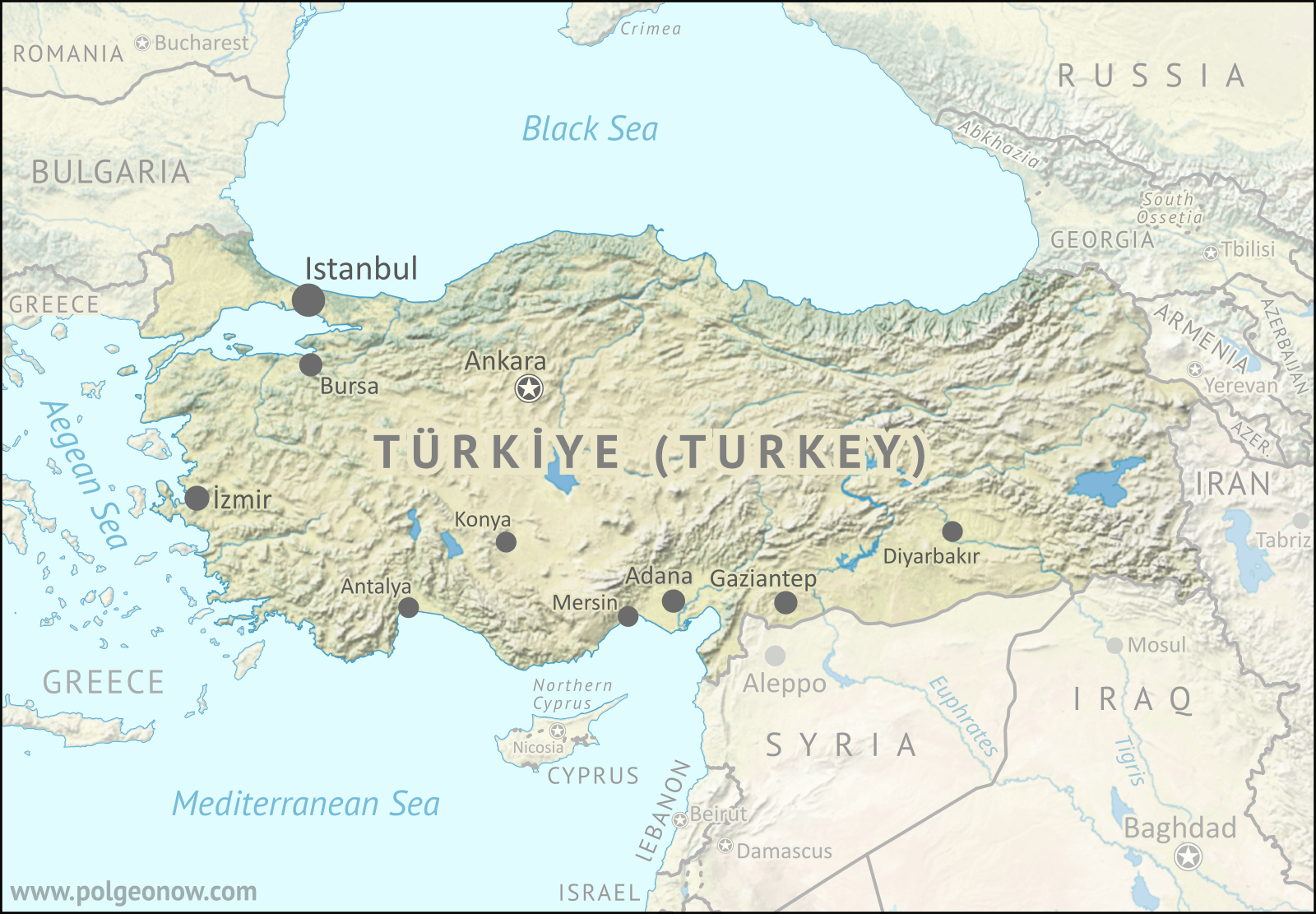
Map of Türkiye, formerly known as Turkey, which officially changed its name in English and other languages in 2022 to match the Turkish-language version. Map is in green, brown, and blue natural style with terrain, showing that more or less the entire country is mountainous, with colors varying from dark green to beige, and most areas in some hue of yellow-green. Turkey is roughly shaped like a long, horizontal rectangle (if north is treated as up), with the Black Sea along its whole northern side and the Aegean Sea to its west, with a small portion of the country in the far northwest (Eastern Thrace) separated from the rectangle (Anatolia) by the rivers connecting those two seas. The southern side of the country is bounded by the Mediterranean Sea in the west and the more-arid land of the Levant and Mesopotamia in the east. East of the country are the mountainous Southern Caucasus region and the northwestern end of the Iranian Plateau. Capital city Ankara is a bit northwest of the country's geographic center, and the larger Istanbul much farther to the northwest, straddling the gap between Eastern Thrace and Anatolia. Other cities of over a million people each, including İzmir, Adana, Bursa, Gaziantep, and several more, are located along the country's western and southern margins. Surrounding countries include Greece and Bulgaria to the west; Cyprus (and disputed Northern Cyprus), Syria, and Iraq to the southeast; and Iran, Armenia, Georgia and Azerbaijan to the east. Russia looms large just across the Black Sea to the northeast, Romania is across the sea to the northwest (plus Ukraine and disputed Crimea directly north), and Israel and Lebanon are not far off along the southward turn the Mediterranean coast, while the Aegean Sea to the west is dominated islands that are part of Greece.
Hidden image for crawlers

Turkey's "New" Name

Over the last two years, PolGeoNow readers might have noticed us using the name "Türkiye" for the country more widely known in English as "Turkey". That's because the Turkish government officially changed the country's name in English (and two other languages) about two years ago, and our policy is to call countries by what their governments say they're called, except in certain special cases. 

Türkiye, a large and influential country traditionally considered to be partly in Europe and partly in Asia, comes up a lot in news about both European and Middle Eastern geopolitics. So that means a lot of people and organizations now have to make a choice: Keep using the name they're used to, or switch the official one chosen by the country's government.

Sunday, April 21, 2024

Map Update: Sweden Joins NATO

Map of NATO allies in 2024, with all members color-coded in dark blue including the newest country to join, Sweden.  Also labels Russia, whose invasion of Ukraine led to Sweden and neighboring Finland choosing to join. The map is projected to appear as if the viewer is looking at a globe, with the North Atlantic Ocean in the center. The left side is dominated by large NATO members the US and Canada, while on the right side the smaller continent of Europe is mostly made up of blue NATO member countries, with a few noticeable gaps. Sweden is located near the upper-right corner, filling in what was previously a large hole in the NATO area, surrounded by member countries Finland, Norway, and (across a narrow strip of sea) Denmark, Germany, Poland, and the Baltic countries. Colorblind accessible.


Graphic modified by Evan Centanni from this map by Wikimedia user Addicted04 (CC BY-SA).

New NATO Ally: Sweden

Northern Europe's Kingdom of Sweden was admitted last month as a full member of the North Atlantic Treaty Organization (NATO), a military alliance of countries in Europe and North America, famous for its opposition to the Russia-led "Communist Bloc" in the 1947-1991 Cold War. Sweden's NATO membership officially went into effect on March 7 after the final paperwork and exchange of documents were completed. Sweden is the 32nd country to join NATO.

Sweden, which had positioned itself as a more-or-less neutral country in the Cold War, chose to join the historically anti-Russia alliance after Russia's full-scale invasion of Ukraine. Sweden applied for membership in 2022 at the same time as neighboring Finland, but took almost a year longer to overcome objections from existing NATO members Türkiye (formerly Turkey) and Hungary.

Saturday, March 9, 2024

Israel / Palestine: Map of Control on March 4, 2024 (Subscription)

SUBSCRIBERS CLICK HERE TO VIEW FULL ARTICLE AND MAP:
Old Portal (members.polgeonow.com) | New Portal (controlmaps.polgeonow.com)


There are newer editions of this map available. To see them, view all Israel articles or Palestine articles on PolGeoNow.

Map by Evan Centanni, timeline by Djordje Djukic with Evan Centanni

Subscribe for full access to all conflict map reports!

Thumbnail preview of map of who controlled Palestine and Israel's claimed territories on March 4, 2024, four months into the Israeli (IDF) ground invasion of the Gaza Strip, and before the threatened assault on Rafah. Shows both Israeli and Palestinian Authority administration (Fatah and Hamas factions indicated separately). Includes bigger West Bank map (Area A, Area B, and Area C). Map also includes Gaza Strip, Golan Heights, major cities and Israeli settlements, UN peacekeeper deployments (UNIFIL in Lebanon and UNDOF in Syria), no man's land, Golan Heights buffer zone (area of separation, AOS), and Shebaa Farms. New edition also shows so-called Gaza Envelope and Confrontation Line zones, the areas of Israel proper are under the greatest military restrictions. Includes all major cities and various key towns and sites from the news, like Khan Yunis, Jabalia (Jabaliya), Maghazi Refugee Camp, Abasan al-Kabira, Kerem Shalom crossing, Jenin, Tulkarm, and more. Now with improved colorblind accessibility.

In the past three months, Israel's counter-invasion of the Gaza Strip has slowly ground on, with the shift focusing from Gaza City in the north to Khan Yunis in the south, and possibly to Rafah next. However, much of the Strip still remains outside of Israeli control, while closely-related violence continues at a lower level in the West Bank, on the Lebanon border, and as far afield as Yemen and Iraq.

See all this and more in the latest update to PolGeoNow's widely-acclaimed map of territorial administration in the Israel/Palestine area. In addition to the updated map, the report also includes a detailed chronicle of changes and events since December 8, 2023, the date illustrated by our previous Israel/Palestine control map.

This map and report are premium content, available to paid subscribers of the PolGeoNow Conflict Mapping Service.

Want to see before you subscribe? Check out our most recent FREE SAMPLE Israel/Palestine map report!

Exclusive map report includes:

  • Up-to-date illustration of current territorial control across all areas claimed by either Israel or Palestine, including Hamas and Israeli military control in the Gaza Strip (not in extreme detail), as well as UN peacekeeper deployments just outside the region
  • Closer-up inset map showing the divisions in the West Bank: Israeli military control (including Jewish settlements), Fatah-led Palestinian jurisdiction, areas of shared administration, and the (annexed) area of Israeli civilian control in East Jerusalem
  • Lines illustrating the pre-1967 ceasefire boundaries separating Israel proper from the Palestinian-claimed Gaza Strip and West Bank, as well as the Syria-claimed Golan Heights
  • Labels for contentious areas, like the Gaza Strip, West Bank, Golan Heights, Shebaa Farms, and "no man's land"
  • Illustration of which parts of Israel proper are subject to the greatest restrictions by military decree under current war powers: the "Gaza Envelope" in the south and the "Confrontation Line" in the north
  • Detailed indication of city-by-city control, including key towns and other locations important to current events, including in the West Bank and along the border with Israel and Lebanon
  • Locations of recent control changes and other important events, including Khan Yunis, Jabalia (Jabaliya), Maghazi Refugee Camp, Abasan al-Kabira, Kerem Shalom crossing, Jenin, Tulkarm, and more.
  • Detailed timeline of important events and changes to territorial control since December 8, 2023, with links to sources.
  • Additional timeline entries chronicling events in all four additional fronts to the conflict: (1) the Lebanon border, where Israel and Hezbollah are engaged in cross-border attacks; (2) the West Bank, where near-daily Israeli raids on Palestinian-governed cities have led to intense clashes; (3) attacks on Western shipping in the Red Sea and Gulf of Aden near Yemen, where the US and UK have retaliated militarily against the "Houthi" government; and (4) tit-for-tat attacks between Iran-backed militias and the US and Israel in Syria and Iraq (Fronts 3 and 4 are not illustrated on the map).

SUBSCRIBERS CLICK HERE TO VIEW FULL ARTICLE AND MAP:
Old Portal (members.polgeonow.com) | New Portal (controlmaps.polgeonow.com)


Not signed up yet? Click here to learn more about our professional subscription service!

Can I purchase just this map?
This map and report are not available for automated purchase to non-subscribers. If you need access or republication rights for only this map report, contact service@polgeonow.com for options.