Monday, September 21, 2026

Africa and the World Map: Six Things Everyone Got Wrong About the UN Vote

At top left, a map using the Mercator projection shows northern regions and Antarctica very large compared to tropical regions, but all in familiar shapes, with the label saying it was invented in the 1500s for navigation, and is mostly discouraged by the UN. At top right, a world map in the Equal Earth projection, without any countries exaggerated in size, but with Africa and other continents appearing to be somewhat stretched or squished - label says it was invented in 2018 as the newest way to preserve country sizes, and is encouraged by the UN for some uses. At bottom left, a world map in the Robinson projection, where northern regions and Antarctica are somewhat exaggerated in size, but much less so than in the Mercator, and the shapes of continents are similar to in Mercator except for some distortion towards the left and right ends. At bottom right, an image simulating a globe with the view centered on Africa, showing that the continent's true shape is indeed closest to that seen in the Mercator and Robinson projections.

Graphic by PolGeoNow, starting from maps by Geordie Bosanko, Justin KunimuneCanuckguy, and Martin23230. You can take and use this image for free, as long as you follow the rules of the CC BY-SA license, and link back to our site when possible – but please consider buying us a coffee if it's useful to you!

Article by Evan Centanni 

Maps at the United Nations: What Really Happened 

The internet has gone wild this month with news about a United Nations (UN) General Assembly resolution, passed on September 4, to endorse what headlines called a “new world map”. (A General Assembly resolution is a kind of official statement about what most of the world’s countries think or want.)

Unfortunately, most reporting on the UN action has been a mix of exaggerations, misunderstandings, and bad simplifications, with people getting mostly the wrong impressions about what happened. And as in past cases, the media mostly didn’t interview the actual map experts. But not to worry – we have one of those here!

US, Ukraine, and More: Which Countries Criticized the UN’s World Map Vote, and Why

Photo of a large, round, high-ceilinged room with many rows of mostly empty chairs, six of them to each elongated wooden desk, divided by four aisles in a gently-sloped amphitheater setup. A dull green carpet covers the entire floor, including a stage at the back of the room, topped by a high raised platform and three chairs that face back into the room. A large slice of the wall behind the stage is covered in coppery golden surface, with a large UN emblem in the middle, and the rest of the walls are mostly covered in dense, vertical wooden slats, with the windows of two wrap-around viewing galleries peeking through.
The UN General Assembly Hall in New York City, where this month's map vote took place. Unlike the smaller UN Security Council, the General Assembly has little power to enforce decisions on countries, and instead exists more for building international consensus, setting goals, and overseeing projects. Photo by PolGeoNow, from November 2019 (contact us for permission to use it).

UN Map Debate: The truth about the US and Ukrainian arguments, and what other countries said

As you might have heard, the United Nations (UN) held a vote early this month about maps, discouraging the use of the mapmaking method known as the Mercator projection, which produces world maps that hugely exaggerate the size of places far from the equator (like northern Europe, Siberia, Canada, and Antarctica). The idea is that this is unfair to countries like those in Africa, which look smaller than they really are compared to countries in more-powerful Europe. The Equal Earth projection was promoted as a good alternative, because it perfectly preserves relative sizes (while introducing other kinds of distortion).

Unfortunately, even major news media got key details wrong – for example, the UN didn’t officially “adopt” or “replace” any map or projection. For the truth about what it really did, check out our separate article on six things most people misunderstood about the UN decision. If you have opinions about map projections, you should definitely read that first! But if you're looking for the details on which countries said what, you're already in the right place...

Sunday, August 30, 2026

Syria Control Map & Timeline: The End of the SDF - August 2026 (Subscription)

SUBSCRIBERS CLICK HERE TO VIEW FULL ARTICLE AND MAP:
Old Portal (members.polgeonow.com) | New Portal (controlmaps.polgeonow.com)


To see other maps in this series, view all Syria updates on PolGeoNow. 

Researched and written by Djordje Djukic and Evan Centanni. Map by onestopmap.com, Djordje Djukic, and Evan Centanni.  
 

Join for full access to all conflict map reports

Thumbnail preview of post-Assad Syria control map: Territorial control in Syria on August 30, 2026, a year and a half after the fall of the Assad government. Color-coded for control by the Syrian Transitional Government (STG) of Ahmed al-Sharaa (formed from former rebels of Hayat Tahrir al-Sham (HTS / Al-Nusra Front), Free Syrian Army, and Syrian National Army rebels backed by Türkiye (Turkey)); remants of the officially-dissolved Syrian Democratic Forces (SDF), including Kurdish YPG and Asayish; the Israeli military (IDF) occupying forces; the so-called Islamic State (ISIS/ISIL); and the Druze National Guard paramilitary force in Suwayda/Sweida province. Also marks remaining Russian bases, recently vacated US base, and areas of major activity involving ISIS in the last five months. Marks locations of recent military importance, including Qasrak airbase, Kobani, Hmeimim airbase (Khmeimim), Mount Hermon (Jabal al-Sheikh), Semalka border crossing, Shahba and Arman (targets of Jordanian airstrikes), al-Mazraa, Ma'ariya, Rmeilan (Rumeilan, Rmelan), the Bishri Mountains, the Safa volcanic area, and many more. Colorblind accessible.

In the past five months, independent Kurdish-led control of the northeast has melted away under a merger agreement with the Syrian national government, leading to this week's announcement that the Syrian Democratic Forces (SDF) have formally ceased to exist (however, claims that integration is complete are greatly exaggerated).

In the southwest, Israeli forces have held their ground and dug in (literally), amid a threat of Israeli civilian "settlements" in the zone, while deep cracks have appeared in Sweida (Suwayda) province's Druze paramilitary "National Guard" coalition, with its leader charting an increasingly controversial political course both internally and externally.

Meanwhile, fighters of the "Islamic State" (ISIS/ISIL) have dramatically reduced their pace of attacks across the country, despite the withdrawal of most US troops, while on the coast, Russia has agreed to share its bases with the Syrian military.

Find the answers to all your questions in our professional report, with full summaries of each major trend and topic, and a detailed, painstakingly-researched timeline of events, with sources cited. Both the timeline and summaries are crafted with care by our dedicated humans - no AI slop. Also included, of course, is the latest update to PolGeoNow's concise, professionally-designed overview map of territorial control in Syria. Subscribe now to see it all.

The included map is dated to August 30, 2026, with the report covering events of the past five months, since the publication of our previous map and report on March 25, 2026.

This map and report are premium content, available to paid subscribers of the PolGeoNow Conflict Mapping Service. Please consider subscribing to support our independent, politically-neutral research and cartography, as we rely largely on readers like you, and are currently struggling for funding.

Want to see before you subscribe? Check out our most recent FREE SAMPLE Syria map report.*

*As conflict has slowed down in Syria, our 2026 reports include deeper coverage of the country's military and administrative landscape than seen in this sample report, with less of the play-by-play chronicling of military movements. 

Exclusive map report includes:

  • Up-to-date illustration of current territorial control in Syria (excluding the Israeli-annexed Golan Heights), color-coded for the Syrian Transitional Government (STG), formed from former rebel groups led by Ahmed al-Sharaa; the last remnants of the Kurdish-led Syrian Democratic Forces (SDF) and affiliates (includes Asayish police and DAANES Rojava government); forces of the so-called "Islamic State" (ISIS/ISIL); the Israeli military (IDF), and the Druze paramilitary coalition known as the National Guard in Sweida (Suwayda) province.
  • Markers showing the location of Russian military bases, and the US's recently-evacuated Qasrak airbase
  • Illustration of major recent active zones for "Islamic State" (ISIS/ISIL) operatives in areas outside the group's control, approximated from ACLED data on incidents both targeting them and perpetrated by them
  • Detailed indication of city-by-city control, including key towns and other locations important to current events
  • Locations of recent control changes and other important events, including Kobani, Hmeimim airbase, Mount Hermon, Semalka border crossing, Shahba and Arman (Jordanian airstrikes), Al-Mazraa, Ma'ariya, and many more
  • Concise, beginner-friendly summary of the current situation and key events over the past five months, covering major developments and trends for each of Syria's major armed parties and administrations
  • Detailed timeline of changes to territorial control, major military events, and key political developments since March 25, 2026, with background explanations and links to sources.

SUBSCRIBERS CLICK HERE TO VIEW FULL ARTICLE AND MAP:
Old Portal (members.polgeonow.com) | New Portal (controlmaps.polgeonow.com)


Not signed up yet? Click here to learn more about our professional subscription service 

Can I purchase just this map?
This map and report are not available for automated purchase to non-subscribers. If you need access or republication rights for only this map report, contact service@polgeonow.com for options.

Tuesday, July 28, 2026

Map Only: Somalia in April 2026 (Subscription)

SUBSCRIBERS CLICK HERE TO VIEW FULL MAP:
Old Portal (members.polgeonow.com) | New Portal (controlmaps.polgeonow.com)
 

(To see other maps in this series, view all Somalia updates.)

Thumbnail: Somalia war map 2026: Territorial control map showing security situation as of April 15, 2026. Marks states, regions, and territorial control, including by Federal Government of Somalia (FGS) in alliance with so-called Ma'awisely (Macawisley, Macawiisleey) militias, the African Union's AUSSOM peacekeepers (formerly ATMIS), and forces of newly-recognized North East State (formerly SSC-Khatumo, SSC-Khaatumo); Al Qaeda affiliate Al Shabaab; so-called Islamic State (ISIS, ISIL, IS-Somalia, ISS); separatist Somaliland; and autonomous states Puntland and Jubaland. Also includes boundaries of the additional federal member states, Galmudug, South West, and Hirshabelle. Shows Jubaland control separate from federal control amid the ongoing standoff between the two, and also labels state capitals and disputed territory between Somaliland and Puntland. Includes estimated areas of Al Qaeda and ISIS presence in the Golis Mountains (Cal Madow and Cal Miskaad) of northern Puntland and Somaliland. Colorblind accessible.

We're still midway through the process of preparing a full 2026 Somalia Control Map and Report, but subscribers who just need the map can find here a “preliminary edition” based on research up to April 15, 2026. 

This map is researched and fact-checked to approximately the same high standards we apply to reports, but is missing the report itself, which would cite our sources and document what changes have occurred since our previous map report in June 2025. That documentation will be covered in the final report coming later this year, which will also update the map up to the present date at that time.

Subscribe for full access to all conflict map reports!

This map is premium content, available to paid subscribers of the PolGeoNow Conflict Mapping Service. 
 
Want to see before you subscribe? Check out our most recent free sample Somalia map


More Somalia Services

PolGeoNow is a world leader in expertise on the geographic details of conflicts in Somalia, with various government and NGO customers relying on us for rigorously-investigated maps of territorial control. The above map is created with reference to PolGeoNow's proprietary database of village-level territorial control assessments, covering the entire territory claimed by Somalia. If you have questions about the sources and rationale for specific mapping decisions, please contact our lead cartographer and we'll be happy to provide answers.

If you're in need of deeper or more detailed information than shown on the map, you can also now contact us for additional services, tailored to your budget. The following are available on a short timeline:

  • Licensing of our Somalia maps for use in your own publications (can be included in custom subscriptions)
  • Direct consulting on subjects like fine-grained territorial control, accurate location of events, and recent history of control for specific locations going back to 2023
  • GIS data consisting of points for towns, villages, and other locations with columns for assessed territorial control at specific points in time; for areas covered by conflict reporting in recent years, this also includes added and corrected locations beyond what's found in widely-available datasets such as OCHA humanitarian info, Google Maps, and OpenStreetMap
  • Place name data documenting the myriad ad-hoc spellings seen in Somali and English-language reporting, to help you quickly find locations mentioned in reporting

With greater lead time, we can also offer services such as:

  • Customized map editions showing the situation on your date of choice (present or past), incorporating additions or modifications as needed for your use case
  • Close-up maps showing territorial control in much more detail for specific states, regions, or areas
  • Shapefile polygons for incorporation of our actual mapped lines of control into your own GIS workflow
  • Mapping the locations of military bases or checkpoints used by the various conflict actors (as compiled from publicly available reporting - we do not do our own ground-truthing research or have access to confidential sources).

For any of the above services, you can directly email Evan Centanni, our lead cartographer and Somalia researcher, at evan@polgeonow.com. All Somalia-related inquiries will be read and receive a timely reply. Have another idea? Run it by us! 

Get in Touch


Sunday, June 14, 2026

World Cup 2026: Which Countries Are (and Aren't) Members of FIFA?

This is an updated edition of our FIFA member countries article, updated and fully revised for the 2026 World Cup in North America! You can also view past versions of the article from 20142018, and 2022.

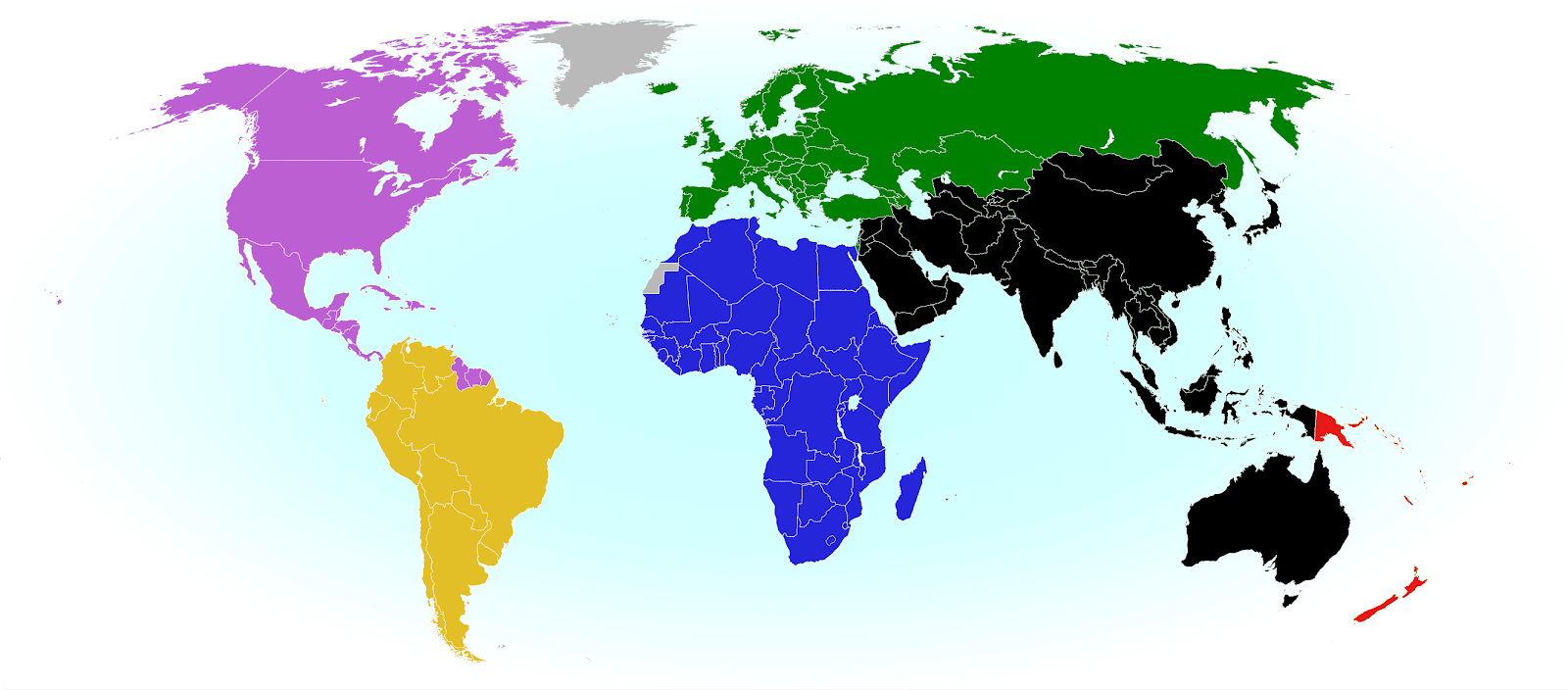
2022 world map showing the six continental confederations of men's national association football (soccer) teams, including all FIFA national teams and World Cup countries. Colorblind accessible.
The six continental confederations of national football teams associated with FIFA. Most, but not all, confederation members are individually members of FIFA too. Map by Evan Centanni, based on work by EOZyo (source).


Around the world, fans of association football - also known in many countries as "soccer" - are about to tune in for the ongoing, month-long men's FIFA World Cup in the US, Mexico, and Canada. Not all the world's countries can advance to the cup, but did they all get a shot at it? Which countries were eligible to enter the tournament, and which are excluded? Read on for PolGeoNow's exclusive guide to the roster of FIFA national football teams...