
This is an updated edition of our FIFA member countries article, updated and fully revised for the 2026 World Cup in North America! You can also view past versions of the article from 2014, 2018, and 2022.
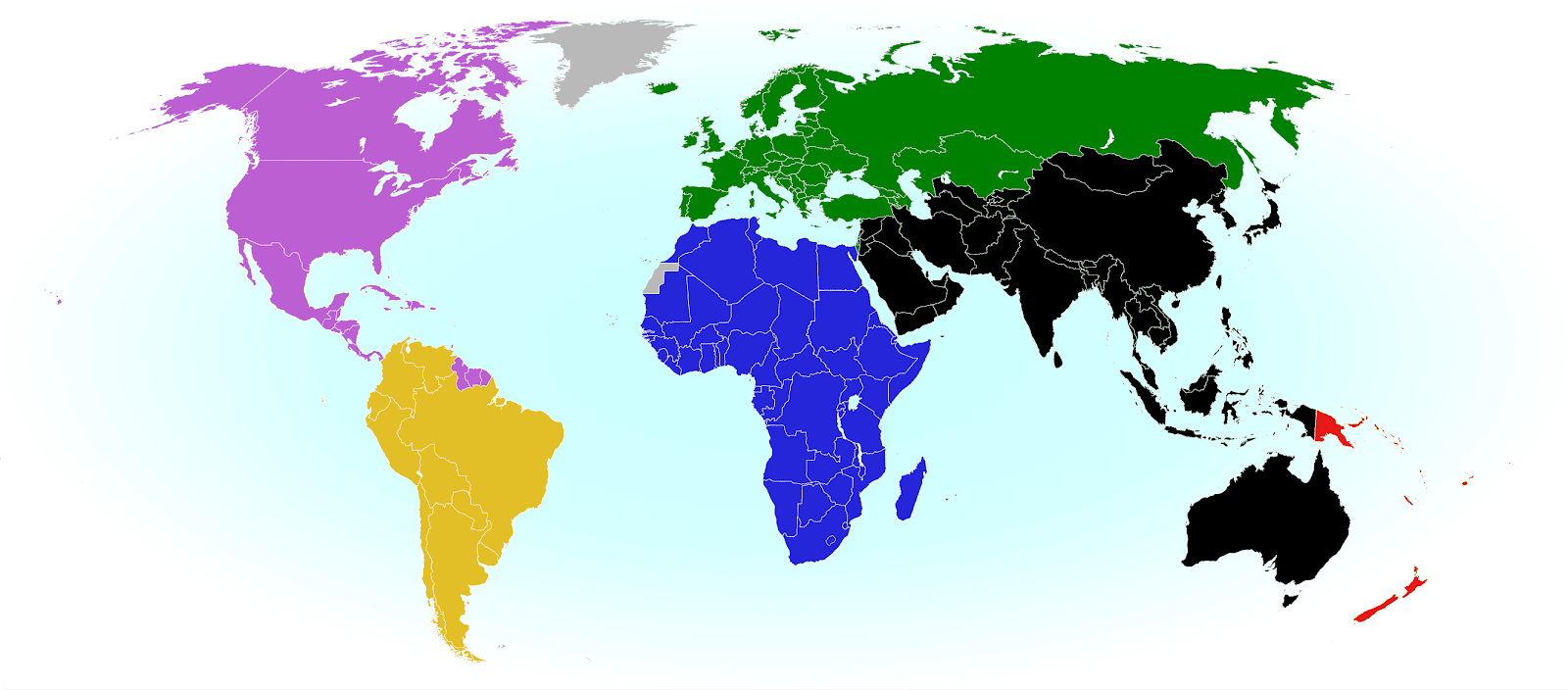 |
| The six continental confederations of national football teams associated with FIFA. Most, but not all, confederation members are individually members of FIFA too. Map by Evan Centanni, based on work by EOZyo (source). |

Around the world, fans of association football - also known in many countries as "soccer" - are about to tune in for the ongoing, month-long men's FIFA World Cup in the US, Mexico, and Canada. Not all the world's countries can advance to the cup, but did they all get a shot at it? Which countries were eligible to
enter the tournament, and which are excluded? Read on for PolGeoNow's exclusive
guide to the roster of FIFA national football teams...
How many FIFA national teams are there?
There are currently 211 national men's football teams officially represented in the Fédération Internationale de Football Association (FIFA), which is required to compete for qualification in the World Cup. Each team is technically represented in FIFA by a football "association" in its home country, which is separate from that country's government, and can represent multiple teams (such as men's and women's teams, and teams in closely-related sports).
FIFA's member associations are divided into six continental confederations that preside over competitions within each region (see map above), though it's possible to be a member of one of these confederations but not of FIFA.
The confederations are loosely based on what continent they're located on, but there are some exceptions: The Asian Football Confederation also includes Australia, Guam, and the Northern Mariana Islands (all usually considered part of Oceania), while South America's Guyana, Suriname, and French Guiana* - which are considered to be culturally Caribbean - are grouped with the Caribbean islands alongside North and Central America. As in the Olympics, Israel is a member of the European confederation despite its location on the Asian continent. Türkiye (formerly Turkey), Kazakhstan, Armenia, Azerbaijan, and Georgia are also grouped with Europe, even though each one is technically located mostly in Asia by the most common definition (Russia also has most of its land on the Asian side of this imaginary line, but at least most of its population is on the western side).
Russia's team was banned from FIFA competition in 2022 over its home country's all-out invasion of Ukraine, in the middle of qualifier matches for that year's World Cup, and it's still shut out
of the World Cup and other FIFA-affiliated events four years later. But
the Russian football association is still considered to be a FIFA member, just one whose teams aren't allowed to play right now.
*As discussed later on, French Guiana is one of the associations that's a member of its continental confederation, but not a member of FIFA itself.
FIFA members that aren't independent countries
You might have noticed that 211 is more than the number of independent countries in the world. After all, the United Nations (UN) only counts 195. That's because, much like the Olympics, FIFA used to allow "national" associations to apply for membership even if they represented dependent territories - places that belong to, or are considered part of, UN member countries, but are separated by large distances or different government systems.
Today, FIFA basically only lets in new associations if they represent UN member countries, or proclaimed countries that most other countries accept as independent. Despite that, all associations that got in before that rule are allowed to stay, even if the place they represent is technically just a subdivision of some UN member country.
Today there are 19 dependent territories whose national football associations are FIFA members, making them eligible to try out for the World Cup:
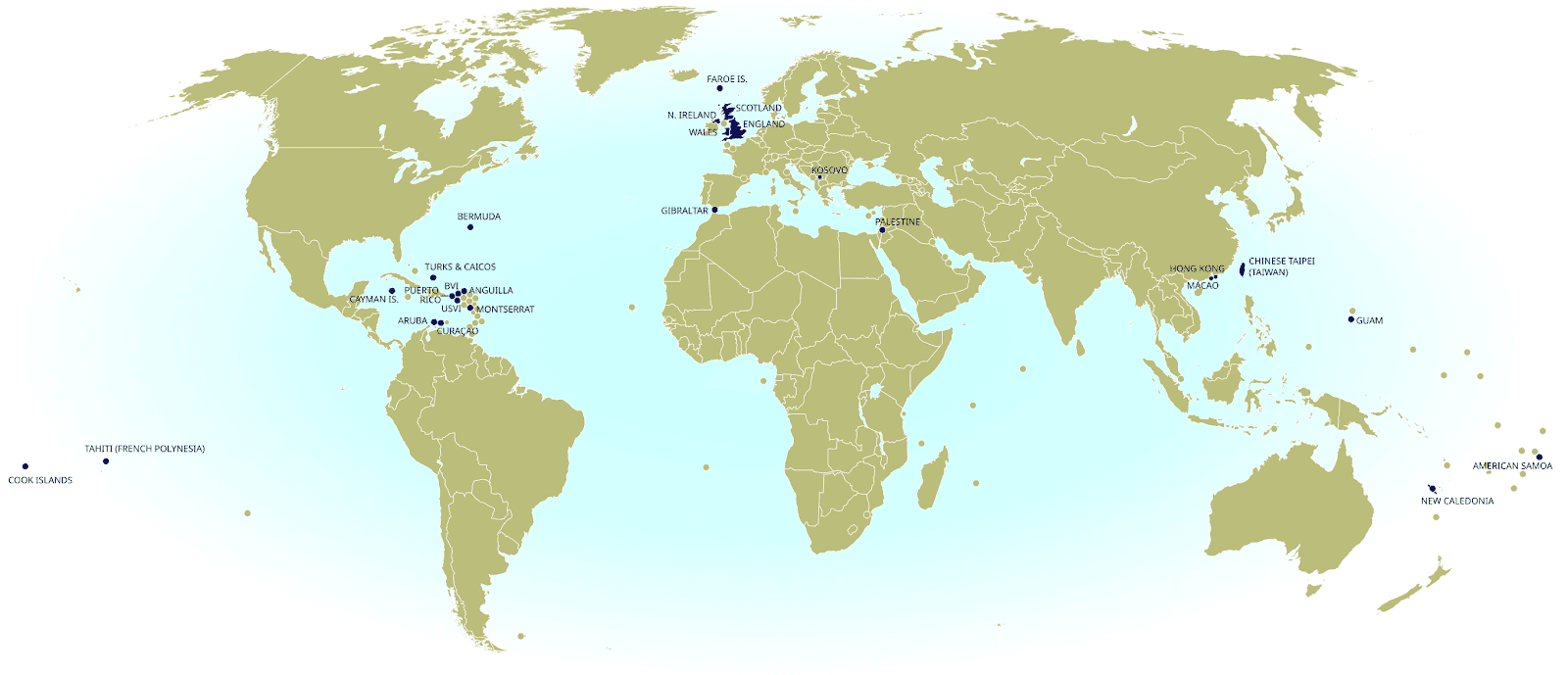 |
| Click to enlarge: FIFA members that aren't UN member countries, including dependent territories, disputed countries, and national subdivisions. By Evan Centanni, from public domain base map (source). |
North America & the Caribbean
 Anguilla (UK)
 Aruba (Netherlands)
 Bermuda (UK)
 British Virgin Islands (UK)
 Cayman Islands (UK)
 Curaçao (Netherlands)
 Montserrat (UK)
 Puerto Rico (US)
 Turks & Caicos Islands (UK)
 US Virgin Islands (US)
Asia
 Hong Kong (China)
 Guam (US)*
 Macau (China)
*As mentioned above, Guam is usually considered to be in Oceania, but its football teams play as part of Asia instead.
Europe
 Faroe Islands (Denmark)
 Gibraltar (UK)
Oceania
 American Samoa (US)
 Cook Islands (New Zealand)
 New Caledonia (France)
 Tahiti (France) - represents all of French Polynesia
And by tradition, each of the four "countries" making up the UK - where the modern version of soccer was invented - has its own separate team, despite not being independent:
 England
 Northern Ireland
 Scotland
 Wales
Wales
Also as in the Olympics, disputed countries Palestine, Kosovo, and Taiwan (known in international sports as "Chinese Taipei") have been allowed in despite not being considered countries by the UN (Palestine actually is now treated as an independent country by the UN, despite not being a full member, but that wasn't yet the case when it first entered FIFA in 1998).
Changes to the list of FIFA countries
No national teams have joined or left FIFA in the four years since the 2022 World Cup in Qatar - the last two to join were Kosovo and Gibraltar in 2016.
Though the number of FIFA members remains the same, there are two teams competing in the tournament under new names this year, both of whom changed their names just before the last World Cup, but failed to qualify for that tournament:
First, the team formerly known as "Turkey" has changed its name to "Türkiye", matching its home country's decision to promote its Turkish-language name even for use in English. The country's name change was registered at the UN in mid-2022, and seems to have entered use almost right away for other FIFA-affiliated events (before that year's World Cup).
Get the Full Story: Your Complete Guide to Turkey's 2021-2022 Name Change
Meanwhile, the Czech Republic registered "Czechia" as its official short name at the United Nations way back in 2016, a full two World Cups ago. Its football team didn't qualify for either of those competitions...but even if it had, it would have still been called "Czech Republic" at the 2018 World Cup. That's because Czech football didn't switch to using the short name until 2022, after a national conference to get all the country's sports teams on the same page.
Understand the Change: Why "Czechia" instead of "Czech Republic"?
Which countries aren't members of FIFA?
As we've seen, even some dependent territories have football assoications that are FIFA members - but there are actually a few independent countries that still don't. And that's even if we only include those that are treated as full countries by the United Nations (UN):
Europe
 Monaco
 United Kingdom (UK)*
 Vatican City
*Because England, Scotland, Wales, and Northern Ireland each have their own memberships, as explained above, there's no team representing the UK as a whole.
Oceania
 Kiribati
 Marshall Islands
 Federated States of Micronesia
 Nauru
Nauru
 Palau
Palau
Tuvalu
Because they aren't members of FIFA, none of these countries' teams can even try out for the World Cup - though
Kiribati and Tuvalu do play in regional competitions, as "associate
members" of the FIFA-affiliated continental confederation for Oceania. But because these countries are full members of the UN, their football associations have a clear path to future FIFA membership if they can get organized enough.
Until recently, the Marshall Islands was said to be the only UN-accepted independent country without any national team at all, FIFA member or not - even tiny Vatican City has one! There's some question of whether the Marshall Islands was really the only one, given how inconsistently the association from neighboring Nauru has fielded an actual team - but overall, Marshallese football was more or less the last to the party.
That's now changed: A national football association was created in the Marshall Islands in 2020, and by early 2025, a proper team had been put together. After playing its first international match soon afterwards, the latest word was that Marshall Islands is trying to join the continental association for either Oceania or Asia, on the way to eventual FIFA membership.
The football association in another neighboring country, the Federated States of Micronesia, has also made an effort towards eventually joining FIFA since the last World Cup.
Disputed countries that are shut out of FIFA
What about proclaimed countries that aren't accepted by the UN? Though we mentioned above that Taiwan and Kosovo have managed to secure
membership in FIFA, associations from other disputed or unrecognized countries haven't. If we only include those that really are governed independently from the UN member countries that claim them as parts, there are six such self-proclaimed countries:
 Abkhazia
 Northern Cyprus
 Somaliland
 South Ossetia
 Transnistria
 Western Sahara
The self-proclaimed Republic of Artsakh - more widely known as Nagorno-Karabakh - was still on this list in 2022, the last time we reported on which countries are blocked from the World Cup. However, in late 2023 its territory was fully taken over by UN member country Azerbaijan, so it no longer counts as being independently governed. (It's unclear whether an Artsakh football team still exists in exile).
Non-independent territories that are left out of FIFA
Similar to independent Kiribati and Tuvalu, there are also nine dependent territories or country subdivisions whose football associations aren't members of FIFA itself, but have either full or partial membership in the FIFA-affiliated continental confederations:
Africa
 Réunion (France)
 Zanzibar (Tanzania)*
*In 2017, Zanzibar was expelled from full membership in the African continental confederation, after being allowed in just four months earlier. However, it has stayed on as an associate member.
North America & the Caribbean
 Bonaire (Netherlands)
French Guiana (France)
Guadeloupe (France)
Martinique (France)
Saint Martin (France)
 Sint Maarten (Netherlands)
Asia
 Northern Mariana Islands (US)
Several other dependent territories have national-style confederations too, even if they're not members of any continental confederation. Notably, Greenland recently tried to join the football confederation for North America, Central America, and the Caribbean, but was rejected in 2025. Meanwhile, New Zealand-affiliated Niue, after being expelled from the Oceania confederation in 2021 for not really having a team, has made efforts towards a comeback.
For a probably-complete list of dependent territories with non-confederation "national" football teams, you can check out Wikipedia's list of non-FIFA associations (which also includes disputed and unrecognized countries and some other special cases).
CONIFA, an organization for non-FIFA soccer, currently counts 37 national-style teams among its members, including some representing dependent territories or disputed countries, but also many cultural communities who don't have even a dependent territory to call their own. More than 50 other teams have been CONIFA members at some point in the past.
Another major non-FIFA organization is the Europe-centered International Island Games Association (IIGA). This one includes associations from a few far-flung dependent territories (some of whom are also FIFA members), but also many islands in Europe that are legally just normal parts of FIFA member countries.
See you next time!
What might change in the next four years? We'll see you back here when we update again for the Morocco-Portugal-Spain 2030 World Cup!
In the meantime, hit us with your questions and feedback on your social media of choice!
Was this article worth as much as a coffee? All our articles and maps are made by real humans, and any donation or tip you can give is deeply appreciated. It helps us keep updating and making cool, useful new stuff. You can give as much or as little as you want!