ラベル original maps の投稿を表示しています。 すべての投稿を表示

2025年7月24日木曜日

2025 Map of the Schengen Area, Europe's Border-free Travel Zone

What is the "Schengen Area"? What's the difference between Schengen and the EU? And which countries does Schengen include? Read on for all the answers, explained in plain English! 

Schengen Zone: Map of the Schengen Area (the European Union's border-free travel zone), color-coded for EU Schengen countries, non-EU Schengen countries, future Schengen countries, and Schengen-exempt EU countries, as well as microstates unofficially participating in the Schengen agreements. Updated to 2025 with the edition of Croatia, Bulgaria, and Romania to the map. Colorblind accessible.
Map by Evan Centanni, from blank map by Ssolbergj. License: CC BY-SA

A
rticle by Evan Centanni

Originally published in March 2016, this article has been updated to July 2025, showing the addition of Croatia, Romania, and Bulgaria to the Schengen Area. We've also overhauled the styling of the map to avoid using the color blue for land areas, which some readers say they find confusing. To find older versions, you can view all Schengen Area articles on PolGeoNow. Our European Union map and explainer article has also been updated to July 2025.

What is the Schengen Area?

If you've traveled in Europe anytime in the last few decades, you probably know that many of Europe's countries have open borders, without any kind of customs or ID check required to cross from one country to another. That's because of the Schengen Agreement, a 1985 treaty that's since been expanded and made into a law of the European Union (EU).

Map: Which Countries are in the European Union in 2025, Which Aren't, and Which Want to Join?

This map and article have been revised and updated to July 2025. No new countries have joined the EU since our last update in 2023, but Georgia has been added as an official candidate for membership. Our Schengen Area map and explainer article has also been updated to July 2025.

EU Countries: Map of European Union member countries and official candidates, and official potential candidate. Updated to July 2025 with addition of Georgia as a candidate country. Also shows EU status of territories in and around Europe, including Gibraltar, Ceuta and Melilla, Akrotiri and Dhekelia, the Channel Islands of Jersey and Guernsey, the Isle of Man, Faroe Islands, and Greenland (colorblind accessible).
Map by Evan Centanni, from blank map by Ssolbergj. License: CC BY-SA

What is the European Union?

Europe's continental union is probably most famous to outsiders for its euro currency and Schengen free-travel area. But it's actually much more than that: After all, the UK, whose exit from the EU in 2020 created a massive political storm, was never part of the Schengen Area or euro currency zone to begin with.

2025年6月19日木曜日

June 2024 Somalia Control Map & Timeline: Height of ISIS Control, Al Shabaab Stalemate

(To see other maps in this series, view all Somalia updates.)Hidden image for crawlers

This is the second of a set of three Somalia reports published in June 2025 covering the past two years of Somalia's civil war, here mapping the situation as of late June 2024. See also our simultaneously-published reports illustrating the situation as of August 2023 and June 2025.

To access our full catalog of map reports covering control in Somalia and many other countries, sign up for our Control Map Subscription Service – popular with major government and international organizations, but available to individual subscribers at just US$19.99 per month!

Somalia territorial control map showing security situation as of June 28, 2024, at the height of so-called Islamic State control in the Almiskat (Cal Miskaad) mountains of Puntland, and before the resurgence of Al Shabaab in central Somalia's Middle Shabelle and Hiiraan regions. Marks states, regions, and territorial control, including by Federal Government of Somalia (FGS) in alliance with so-called Ma'awisely (Macawisley, Macawiisleey) militias and African Union's ATMIS peacekeepers; Al Qaeda affiliate Al Shabaab; so-called Islamic State (ISIS, ISIL, IS-Somalia, ISS); separatist Somaliland; autonomous state Puntland and aspiring state SSC-Khatumo (SSC-Khaatumo); and boundaries of additional federal member states Galmudug, Jubaland (Jubbaland), South West, and Hirshabelle. Also labels state capitals and disputed territory between Somaliland and Puntland, as well as areas formerly contested in the Ga'an Libah (Gacan Libaax) insurrection (also known as Dulmidiid/Duml Diid). Features key towns from recent news, including Elbur (Ceel Buur), Elgaras (Ceel Garas), Osweyne (Cowsweyne), Run Nirgod (Ruun-Nirgood), Ji'ibow (Jicibow), Bulo Haji (Buulo Xaaji), Dhadar (Dhaadaar), Tasji' (Tasjiic, Tisjiic), Goja'ade (Goojacadde), Geriley (Gherille), and many more. Colorblind accessible.
Base map by Koen Adams of onestopmap.com, with design and control by Evan Centanni. To use this map in your own materials, please contact us to arrange permission.

Article and timeline by Evan Centanni

Mapping Somalia in 2024: Al Shabaab Stalemate and the Height of ISIS Control

This report covers the period in Somalia’s civil war from August 26, 2023 to June 28, 2024, before the events of early 2025, which would see a major Al Shabaab resurgence in central Somalia, as well as the retreat of the so-called “Islamic State” (IS, formerly ISIS/ISIL) during Puntland state’s “Operation Lightning’” (Hilaac) in the remote mountains of the north. In retrospect, the time from mid-2023 to mid-2024 now looks like a period of relative calm – particularly as the war between Somaliland and SSC-Khatumo settled into a state of frozen conflict - but there were still a number of important developments, which are summarized in the following paragraphs and covered in more detail in the event timeline further below (where additional sources are cited in the form of in-line links). In brief, this period included:

  • The rollback of recent pro-federal gains in central Somalia's Galgadud region after the coalition's defeat at Osweyne, returning Al Shabaab’s area of control there to its previous extent from 2022 (including Elbur and, for a time, Eldher as well)
  • Federal-aligned forces’ temporary capture, lasting for several months, of the most prominent settlements held by Al Shabaab in neighboring Mudug region (Ba’adweyn, Amara, and Qey’ad), and lasting control of Bulo Haji, a key outpost in Lower Juba
  • The defeat of Al Shabaab in northern Somalia's Almiskat Mountains at the hands of the so-called "Islamic State" (ISIS/ISIL), which was then able to consolidate power and reach roughly its all-time peak of control in Somalia
  • Progress in the planned reduction of the African Union’s ATMIS “peacekeeping” force, with the number of bases handed over or closed reaching at total of 18 out of roughly 70
  • Political turmoil as the Somali federal government turned against ally Ethiopia over a deal that country struck with self-proclaimed independent Somaliland
  • A major escalation in the “Hiran State” movement, with its supporters clashing with federal forces and capturing key sites in Beledweyne city
  • The end of the “Ga’an Libah” insurrection in central Somaliland
  • Self-governed Puntland state’s latest exit from federal politics, announcing that it would act “independent” even while continuing to say it was part of Somalia

2024年12月9日月曜日

Syrian Civil War Reignites: Map of Control Amid Rebel Advance (Dec. 6, 2024)

This map shows the situation on December 6, 2024, just before the final collapse of the Bashar al-Assad government in Damascus. Though the cities of Homs and Damascus have reportedly come under rebel control since then, the country is now in such disarray that current control can't be accurately mapped. 

We plan to publish an update for our subscribers within the next few days, clarifying post-Assad control once the dust has begun to settle.

There are newer editions of this map available. To see them, view all Syria updates.

Syrian Civil War map: Territorial control in Syria on December 6, 2024, ten days into the surprise rebel offensive, and just before their advance led to a full collapse of the Assad government (Free Syrian Army rebels, Kurdish YPG, Syrian Democratic Forces (SDF), Hayat Tahrir al-Sham (HTS / Al-Nusra Front), and others). Includes areas of major known activity for so-called Islamic State (ISIS/ISIL), Turkish/SNA control, joint SDF-Assad control, and US deconfliction zone, plus recent locations of conflict, including Aleppo, Hama, Daraa, Deir ez-Zor, and more. Colorblind accessible.
Base map by Koen Adams of onestopmap.com, with territorial control by Djordje Djukic and Evan Centanni. Area of IS activity is based on 2024 data from ACLED (see footnote for full citation), and reflects a change in methodology from previous editions.
Contact us for permission to use this map.

Timeline by Djordje Djukic

Return to War: Lightning Offensive and Countrywide Shifts

Twelve days ago, Syria's 13-year-old civil war, mostly dormant for the past four years, exploded back onto the scene with a surprise rebel offensive out of the northwest, which quickly managed to seize the country's second largest city, Aleppo. The lead rebel group was the former Al Qaeda affiliate Hayat Tahrir al-Sham (HTS), though Turkish-backed rebels from the northern border regions also joined the fray, with the two groups quickly taking over the country's second largest city, Aleppo. 

As hardline HTS-led forces marched rapidly south, two more rebel fronts emerged, with US-backed fighters in the southern desert expanding out of their longtime safe zone, and a reborn opposition in the southwest recapturing the former rebel stronghold of Daraa. Meanwhile, the Kurdish-led Syrian Democratic Forces (SDF) moved to consolidate their control in the north and east, and over the next ten days moved into areas west of the Euphrates River - including the major city of Deir ez-Zor - as the Syrian military withdrew.

December 6th - the date illustrated on the map above - saw the Syrian military's last major resistance to the surprise rebel assault. The next two days would be a period of government free fall, with rebels apparently entering the city of Homs and national capital Damascus without much resistance. Meanwhile, authoritarian president Bashar al-Assad fled the country as his military withdrew from both cities and the country's central desert, conceding victory in the central conflict of the country's 13-year civil war.

Assad Has Fallen: What's Next for Control in Syria?

Syria is now in disarray, and many questions remain to be answered. What kind of new government will emerge in Damascus? Will former government loyalists hold onto the country's now-isolated coastal region, a traditional bastion of Assad's supporters and still host to his Russian military allies? Will democracy-minded rebel groups work together with the religious-hardline HTS, turn against it, or go their own way in their own strongholds? 

One thing that does seem certain: Syria's division isn't over yet. Even if a rebel coalition government secures power over the country's whole west and center, much of the north and northeast remain under control of the Kurdish-led SDF. While the SDF and the provisional government of its controlled areas do still consider themselves part of Syria, they'll likely be in no hurry to submit to any rebel-led administration. For one thing, they're determined to guarantee rights for Syria's Kurdish people before any future reintegration - and likely under pressure from its US patrons to continue the fight against the so-called "Islamic State" (IS, formerly ISIS).

But the Kurdish-led forces in the northeast also aren't on good terms with either of the two most powerful rebel factions. With Türkiye's government labeling the Kurdish militias at the core of the SDF's forces as terrorist groups, Turkish-backed rebels are more enemies than friends to the US-backed coalition (despite the US and Türkiye being allied with each other as fellow NATO members). Meanwhile, it probably goes without saying that the pro-democracy, fiercely anti-IS, US-supported SDF will be wary of cooperation with the religious-hardline HTS, who many fear could become the next Taliban.

To follow our further coverage as post-Assad territorial control develops, visit or bookmark our listing of all Syria control map reports.

2024年6月11日火曜日

Sudan Control Map & Timeline: Former Rebels Join Fight - June 2024

Hidden image for crawlers(To see other maps in this series, view all Sudan articles on PolGeoNow.)

This marks the first fully up-to-date edition of our new Sudan map series, after several retrospective reports on the situations in previous months. The latest of those, featuring a map of control at the end of January 2024, is being published alongside this one. 

To access our full catalog of map reports covering control in Sudan and many other countries, sign up for our Control Map Subscription Service - popular with major government and international organizations, but available to individual subscribers at just US$19.99 per month!

Sudan War: Map of who controlled what in Sudan on June 11, 2024, showing the situation after most of Darfur's former rebel Joint Force joined the fight alongside the army. Best Sudan control map online, thoroughly researched for maximum accuracy. Shows territorial control by the government-affiliated Sudanese Armed Forces (SAF), the Rapid Support Forces (RSF) paramilitary, and rebel groups in Sudan including the Sudan Liberation Army/Movement's Abdelwahid El Nur faction (SLA-AW/SLM-AW) in Darfur's Jebel Marra, the SPLM-N faction of Abdelaziz El Hilu in the Two Areas of South Kordofan (Nuba Mountains) and Blue Nile. Also shows the area of control of the Ngok Dinka Abyei Area Administration (AAA) within the disputed Abyei Box, and the known bases and area of operation of the remaining Neutral Joint Force of former rebels in Darfur who haven't taken sides. Includes disputed territories claimed by other countries, including the Halaib Triangle, Bir Tawil, and Wadi Halfa Salient along the border with Egypt, plus Kafia Kingi, 14-mile, Abyei, Heglig (Hejlij), Kaka, and Bebnis along the South Sudan border, showing which parts are controlled by which country. Includes key towns and other locations from the news, including the Sennar Sugar Factory, Omdurman, Bahri, El Fau (Al Fao), Jebel Dayir, Delling (Dilling, Dalang), Zurrug, Mellit, Korma, Ayn Siro, Tina border crossing, Misteriya, Al Dabbah (El Debba), Babanusa, Lagawa (Laqawa), Um Rawaba and many more.
Map by Evan Centanni and Djordje Djukic, starting from base map by Koen Adams of onestopmap.com. "Neutral Joint Force" has been redefined to exclude Darfuri former rebel groups who have joined the fight against the RSF, now subsumed under "Govt./SAF & allies". See below for a detailed accounting of which groups are included in each territorial control category. To use this map in your own materials, please contact us to arrange permission.

Timeline by Djordje Djukic and Evan Centanni

Darfur's Joint Force Enters War Against RSF, Kicking off Battle of El Fasher

In the four months since the date depicted on PolGeoNow's previous Sudan control map, lines of control have remained mostly stable, except for a major SAF breakthrough within the city of Omdurman and the RSF's takeover of Mellit, the headquarters of Darfur's Joint Force coalition. Other changes to the map have been made to show where new evidence has emerged of RSF presence (or lack thereof), but these don't represent major victories or defeats. The bigger story has, instead, been a critical realignment in alliances.

The leaders of Darfur's most prominent "Joint Force" former rebel groups, the SLM-MM and JEM-Jibril, have been outspoken against the RSF since November 2023, even recruiting and training new SAF-allied forces in eastern Sudan. But until recently, their field commanders based in Darfur, where the core of each group's forces were stationed, had kept unofficially neutral in the war, helping preserve a year-long, citizen-mediated ceasefire in the city of El Fasher. That all changed after Joint Force troops started fighting alongside the SAF around Khartoum in late March, leading to RSF retaliation across Sudan. By mid-April, the group's major commanders in Darfur had joined the fight, kicking off a devastating, full-scale battle for the region's capital.

A few months ago, "neutral Joint Force" was a useful label for most of the former rebel forces in Darfur, but today it can only fairly apply to the minority of factions who refused to enter the battle, and now say they're launching an official "Neutral Joint Force" separate from the larger SAF-allied one. Our map has been changed accordingly, now subsuming SAF-allied groups within "Govt./SAF and allies", while reserving the "Neutral Joint Force" symbols from the January map for the new strictly neutral coalition. Nearly every Darfuri former rebel group has split into factions over the question of whether to ally with the SAF (the longtime leaders of the SLM-TC and GSLF, alongside their loyalist factions, head the neutral camp).

2024年3月1日金曜日

Ukraine: Map & Timeline of Russian Control in October 2023

There are newer versions of this map available. To see them, view all Ukraine articles on PolGeoNow.

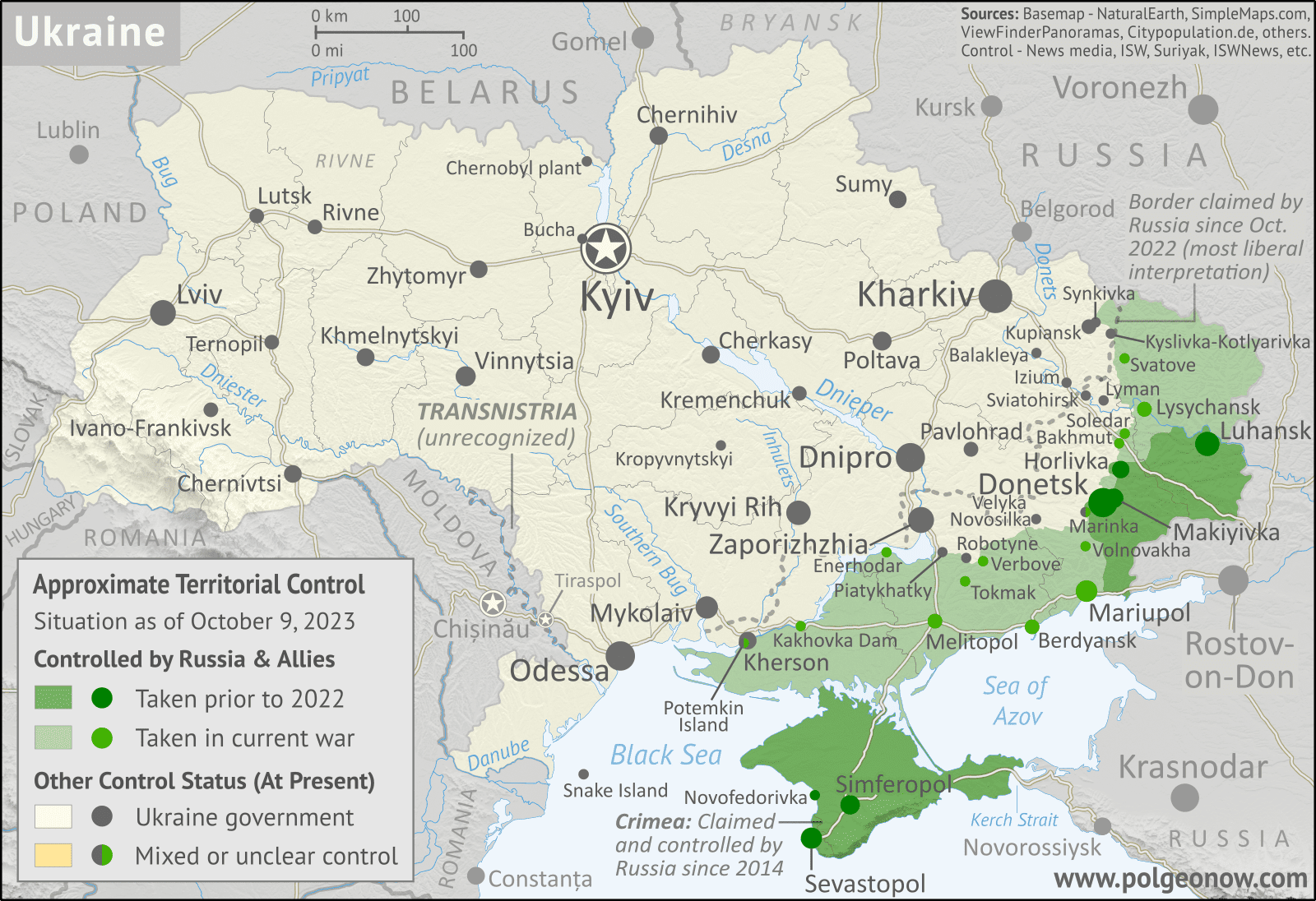
Map of Russian-controlled territory in Ukraine on October 9, 2023. In addition to the Crimean peninsula, which Russia had already seized in 2014, and parts of the far eastern Donetsk and Luhansk provinces (the Donbas region) already controlled by Russia-backed separatist rebels (and formerly declared independent as the Donetsk and Lugansk People's Republics), Russian forces still controlled a wide belt of territory just north of Crimea, including large parts of Kherson and Zaporizhzhia provinces, as well as large additional areas of Donetsk and Luhansk provinces. Meanwhile, all of those provinces are now claimed by the Russian government as parts of Russia, creating a new claimed international border through what was until recently undisputed eastern Ukraine. From August to October 2023, Ukraine made some small advances, capturing two or three significant towns from Russian forces. Map includes key locations from the news, such as Robotyne, Synkivka, Sevastopol, Verbove, and more. Colorblind accessible.
Map by Evan Centanni and Djordje Djukic. Contact us for permission to use this map.

Timeline by Djordje Djukic

Map of territorial control within the claimed borders of the self-declared Donetsk People's Republic (DPR) and Lugansk People's Republic (LPR), which now consider themselves part of Russia, updated to October 9, 2023, months into Ukraine's 2023 counteroffensive. Map shows that the vast majority of the LPR, otherwise known as Ukraine's Luhansk province, is now under the control of Russia, while Russian forces also control over half of the DPR, or Ukraine's Donetsk province, including the major central and southern cities of Donetsk, Horlivka, Makiyivka, and Mariupol. Includes key locations from the news, such as Klischivka, Yakovlivka, Avdiivka, Marinka, Karmazynivka, and many more. Colorblind accessible.
Map showing what parts of the claimed territory of the self-declared Donetsk and Lugansk People's Republics - now claimed as part of Russia - are controlled by Russian forces and allies, compared to the Ukrainian government. Click to enlarge. Map by Evan Centanni and Djordje Djukic. Contact us for permission to use this map.

Ukraine retakes towns amid slow-going counteroffensive

(The maps in this report show the situation as of October 9, 2023. Further territorial changes will be covered in an upcoming update.) 

Between our previous Ukraine control map of August 2023 and early October, Ukrainian forces managed to secure control of some significant towns and other locations from their Russian opponents, despite Russia having gained more ground overall since the beginning of the year.

Ukraine's capture of Robotyne town in Zaporizhzhia province marked a small step in its efforts to break the Russian "land bridge" of territory connecting Crimea and Donetsk, the focus of Ukraine's much-hyped but ultimately bloody and anticlimactic 2023 counteroffensive.

Meanwhile, the northeastern town of Synkivka was restored to full Ukrainian control after being partly occupied by Russian forces, and Klischivka town, south of the small eastern city of Bakhmut, was captured by Ukraine. In the Black Sea, Ukraine brought the war to the Russian stronghold of Crimea, capturing offshore oil rigs and launching damaging attacks on Russia's navy in Sevastopol.

2023年12月11日月曜日

Israel / Palestine: Map of Control After End of Truce (December 8, 2023)

Hidden image for crawlersThere are newer editions of this map available. To see them, view all Israel articles or Palestine articles on PolGeoNow. 

This map shows the approximate situation on December 8, a week after Israel and Hamas resumed fighting in the Gaza Strip after a seven-day "humanitarian pause".

Map of who controlled Palestine and Israel's claimed territories early on December 8, 2023, one month into the Israeli (IDF) ground invasion of the Gaza Strip, and a week after the end of the humanitarian pause (ceasefire/truce). Shows both Israeli and Palestinian Authority administration (Fatah and Hamas factions indicated separately). Includes bigger West Bank map (Area A, Area B, and Area C). Map also includes Gaza Strip, Golan Heights, major cities and Israeli settlements, UN peacekeeper deployments (UNIFIL in Lebanon and UNDOF in Syria), no man's land, Golan Heights buffer zone (area of separation, AOS), and Shebaa Farms. Now also shows Israel's closed military zones (closed military areas) and key towns and sites from the news, like Gaza City, Khan Yunis, Beit Hanoun, Jabalia, Erez Crossing, Jenin, and Kiryat Shmona (Qiryat Shemona). Now with improved colorblind accessibility.
Click to enlarge. Map by Evan Centanni, incorporating base map by Koen Adams of onestopmap.com and data from B'Tselem's interactive mapping project. (Contact us for permission to use this map.)

Timeline by Djordje Djukic, with additional reporting by Evan Centanni

Gaza Strip Divided

Just as we were publishing the previous edition of our Israel/Palestine control map, Israel began its long-expected counter-invasion into the Palestinian territory of the Gaza Strip, responding to hardline Palestinian group Hamas's unprecedented October 7 invasion of Israel. Now, one month into Israel's counter-invasion and two months into the war, the densely-populated Gaza Strip is divided between Hamas-led forces and the Israeli military. 

Israeli forces have seized large parts of Gaza City, the biggest population center in the densely-populated Strip, and completely surrounded the parts of it and nearby towns that are still under Hamas control. Meanwhile, since the temporary humanitarian ceasefire between Hamas and Israel ended a week ago, Israel has also pushed deep into the southern Gaza Strip city of Khan Yunis. For more information on control within the Gaza Strip, maps by online conflict-tracker Suriyak and ISW/Critical Threats give good detailed approximations.

Since our last report, Israel's military has appeared to confirm that it's killed at least about 5,000 Palestinian fighters and 10,000 Palestinian civilians, about ten times the respective numbers of Israeli soldiers and civilians killed by Hamas and allies in their brutal October 7 rampage through the Israeli countryside. This is roughly in line with estimates from the Hamas-affiliated Gaza Health Ministry, which as of Friday estimated a total of 17,000 Palestinians killed, about a third of them adult men (who are assumed to make up the vast majority of Hamas fighters).

2023年10月11日水曜日

Israel / Palestine Map: Who Controlled What Before the 2023 Hamas Invasion?

This article was originally published in July 2020, but has been revised and updated to October 2023. The design of the accompanying map has also been slightly revised, but there were no changes to territorial control between the previous edition and this one except for the reopening of the Gaza fishing zone.

This map shows the situation just before the current war began. For the war itself, check out our new map showing control at the height of the October 2023 Hamas invasion the next day.

Map of who controlled Palestine and Israel's claimed territories on October 6, 2023, just before Hamas's invasion and the start of the current war. Shows both Israeli and Palestinian Authority administration (Fatah and Hamas factions indicated separately). Includes bigger West Bank map (Area A, Area B, and Area C). Map also includes Gaza Strip, Golan Heights, major cities and Israeli settlements, UN peacekeeper deployments (UNIFIL in Lebanon and UNDOF in Syria), no man's land, Golan Heights buffer zone (area of separation, AOS), and Shebaa Farms. Colorblind accessible. Also file under: Palestine controlled area map, How much of Israel is Palestinian land?
Click to enlarge. Map by Evan Centanni, incorporating base map by Koen Adams of onestopmap.com and data from B'Tselem's interactive mapping project. (Contact us for permission to use this map.)

Israel and Palestine Controlled Areas: Before the War

October 2023's surprise invasion of Israel by Palestinian fighters from the Gaza Strip has catapulted the area back to the top of world headlines, and the situation on the ground is now in flux. But what exactly was the situation just before this new chapter of the conflict started? This newly-revised version of PolGeoNow's Israel/Palestine explainer article answers all your questions about who's who and what the significance of each disputed zone is. 

The accompanying map has also been slightly revised and newly fact-checked to ensure that it shows the situation accurately as of October 6, 2023, the night before the Hamas-led invasion of Israel (the only change to control is that the Gaza Strip fishing zone was apparently open for most of this year, rather than closed as it was at the time of our 2021 update).

Note that this is a map of who actually controls what, not of who claims which areas. And it's definitely not supposed to imply that any particular party should or shouldn't control any particular area. As always, PolGeoNow takes no side in these disputes, and we have done our best to report only the facts.

2023年6月5日月曜日

Which Countries Use the Euro in 2023? (Map of the Eurozone)

July 2025 Note: The map is still correct today. We hope to publish a fully-reviewed and revised version of the article soon.

This map and explainer article, originally from 2016, have been updated to June 2023 to cover the recent addition of Croatia to the Eurozone. You can see previous versions of the map by viewing all Eurozone articles on PolGeoNow.

Map of the Eurozone (euro area), showing which countries use the euro as their currency. Includes members, pre-members (ERM II or ERM-2 waiting area), EU non-members using the euro, and other EU countries. Color blind accessible. Updated to June 2023 with the recent entry of Croatia into the Eurozone.
Map by Evan Centanni, from blank map by Ssolbergj. License: CC BY-SA

Article by Caleb Centanni and Staff Writer 

What is the Eurozone?

Officially called the "euro area", the Eurozone is a nickname for the group of countries in Europe that share a single currency, called the euro, as their official money. The euro currency is managed by the European Union (EU), but many countries in the EU don't use the euro, and some countries outside the EU do use it. The European Central Bank, headquartered in Frankfurt, Germany, is in charge of regulating the currency and making euro coins and bills (bank notes).

2022年4月12日火曜日

Yemen Control Map & Report: Truce Pauses Fighting - April 2022

There are newer versions of this map available. To see them, view all Yemen articles on PolGeoNow.
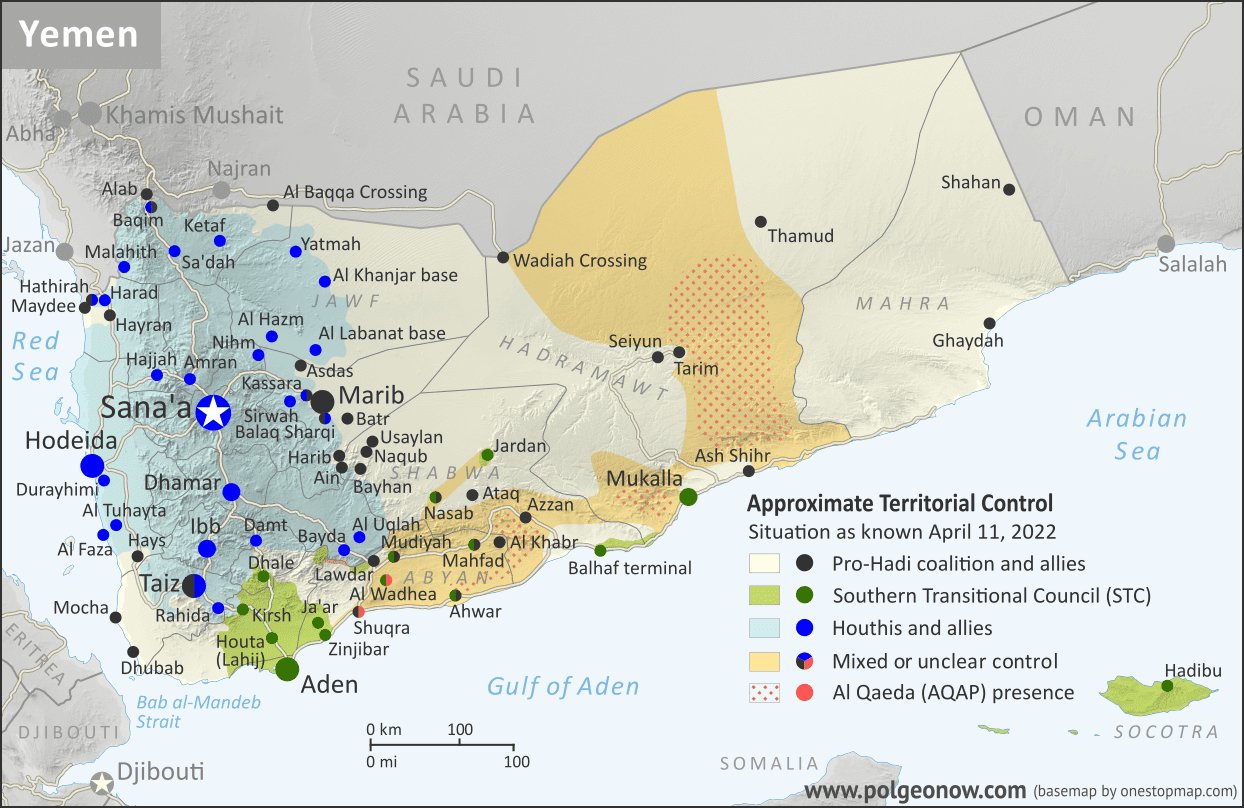
Map of what's happening in Yemen as of April 2022, showing territorial control at the time of the new truce (ceasefire), including the unrecognized Houthi government, the former forces of president-in-exile Hadi (now resigned) and his allies in the Saudi-led coalition, and the UAE-backed southern separatist Southern Transitional Council (STC), plus major areas of operations of Al Qaeda in the Arabian Peninsula (AQAP). Includes recent locations of fighting and other events, including Harib, Harad, Maydee (Midi), Yatmah, and many more.
Map by Evan Centanni and Djordje Djukic, from base map by Koen Adams of onestopmap.com.
Contact us for permission to use this map.

(View this article in the member area)

Timeline by Djordje Djukic, with additional reporting by Evan Centanni

Yemen's New Truce: Who Controls What?

Since our previous Yemen control map report of three months ago, forces of Yemen's unrecognized, Iran-backed Houthi government have rolled back their rivals' recent gains, but still haven't been able to move on the central city of Marib. Amid this stalemate, a surprise UN-brokered truce, alongside the resignation of the country's weak internationally-recognized president, has opened up new possibilities for an end to the war.

2022年3月7日月曜日

Ukraine: Map of Russian Control on March 6, 2022

There are newer versions of this map available. To see them, view all Ukraine articles on PolGeoNow.
Map of Russian-controlled territory in Ukraine during the second week of the Russian invasion (March 6, 2022). In addition to the Crimean peninsula, which Russia had already seized in 2014, and parts of the far eastern Donetsk and Luhansk provinces (the Donbass region) already controlled by Russia-backed separatist rebels (and declared independent as the Donetsk and Lugansk People's Republics), Russian forces have moved into large areas of the countryside north of Ukrainian capital city Kyiv (Kiev), along a long slowly-growing swath of the northeastern border adjacent to Kharkiv city, and in a growing chunk of territory just north of Crimea, including Kherson city and parts of Mariupol, while also expanding control somewhat in Donetsk and much more in Luhansk, covering most of that province. Map includes key locations from the news, such as Kherson, the Zaporizhzhia nuclear power plant, Volnovakha, Kharkiv, Romny, Mykolaiv, Bobrovytsya, and more. Colorblind accessible.
Map by Evan Centanni and Djordje Djukic. Contact us for permission to use this map.

(Subscribers click here to view this article in the member area)

Timeline by Djordje Djukic

Ukraine Map: Russian Troops Gradually Advancing

In the week since our previous Ukraine control map report, Russia and allied rebels have continued expanding their control at a modest pace, seizing the small city of Kherson in the south, expanding separatist control to cover most of Luhansk province, and bringing the port city of Mariupol under siege. Kherson, though the largest city yet captured since the full-scale invasion began on February 24, isn't the biggest city taken from Ukraine by Russia overall, since the slightly larger Sevastopol and Simferopol in Crimea have been controlled by Russia since 2014 (meanwhile, the much larger city of Donetsk, as well as somewhat larger Luhansk, have also been controlled by pro-Russian rebels since that time).

2022年1月25日火曜日

Ethiopia War Map: Tigray Rebel Advance on Capital & Control Today (Nov. 2021/Jan. 2022)

(There are newer versions of this map available. To see them, view all Ethiopia articles on PolGeoNow.)
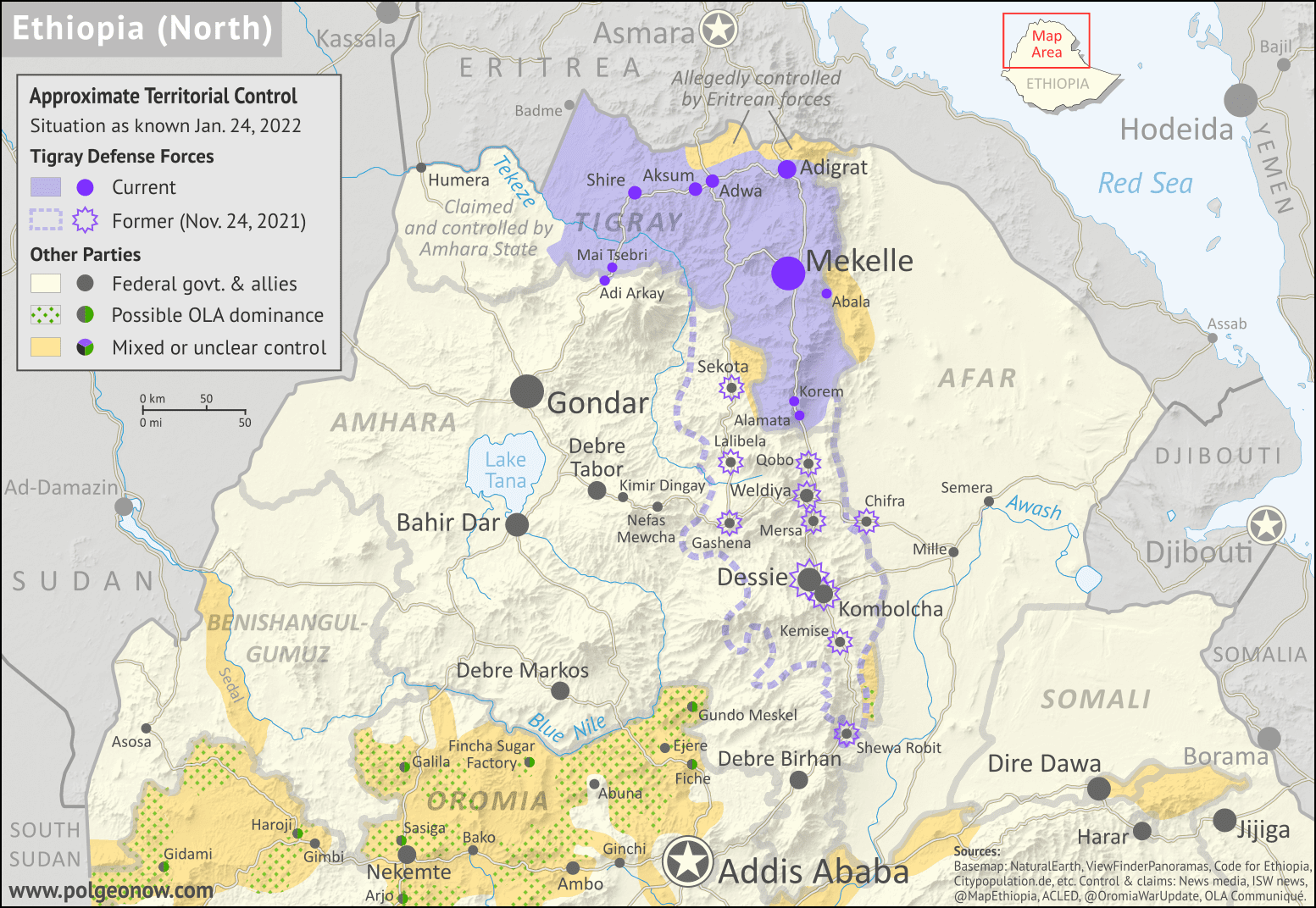
As a followup to the three Tigray war maps we've published as guest features from Daniel of Passport Party, PolGeoNow is pleased to present our new in-house map of control in Ethiopia's ongoing civil war. The new map shows Tigray rebel control both today and at its greatest extent last November, while also highlighting a second insurgency by allied rebel group the Oromo Liberation Army.

Ethiopia war map for late 2021 and early 2022, showing Tigray rebel control both at its height in November 2021, extending far down into Amhara state and near national capital Addis Ababa, and at present day (January 24, 2022). Also indicates areas claimed to be controlled by the Oromo Liberation Army in western and central Ethiopia. Colorblind accessible.
Map by Evan Centanni and Djordje Djukic. Terrain data sourced from ViewFinderPanoramas.
Contact us for permission to use this map.

(Subscribers click here to view this article in the member area)

Timeline by Djordje Djukic, with additional reporting by Evan Centanni

Rebel Advance on Addis Ababa - and Subsequent Retreat

In the five months since our previous report on Ethiopia's civil war, Tigray rebels expanded their control far south of their home state's borders, nearly reaching the national capital city of Addis Ababa. However, despite assistance from another Ethiopian rebel group, their gains were eventually reversed, with Ethiopian federal government forces and allies pushing them back within the boundaries of Tigray state. Now, the situation has almost returned to the same place it was when the war began, with Tigray largely controlled by rebels associated with its former state government, while neighboring Amhara state controls its own territory plus a section of western Tigray.

2021年10月13日水曜日

Somalia v. Kenya: 3 Maps Explaining the Maritime Dispute & Court Ruling

Thumbnail image combining the three maps of the Kenya-Somalia maritime dispute, showing the two countries' overlapping territorial sea, EEZ, and continental shelf claims as well as the judgement reached in the ruling of the UN's International Court of Justice (ICJ). The full-size maps are each included separately, with full alternate text, farther down on this page.
Scroll down for the full-size maps

The UN's main court for disputes between countries, the International Court of Justice (ICJ), ruled yesterday on a contentious case many years in the making: Kenya and Somalia's dispute over the rights to a large slice of the Indian Ocean off their coasts.

While other news outlets analyze the politics and economics of the dispute, it's PolGeoNow's job to give you a clearer, more detailed explanation of its geography. And as shown in the three all-new map infographics below, that geography is a bit more complex than most news articles let on.

Scroll down to see each map at full size, along with concise explanations expanding on the information within the graphics...


2021年7月20日火曜日

Central African Republic Control Map & Timeline - July 2021

There are newer versions of this map available. To see them, view all Central African Republic articles on PolGeoNow. 

We've revived and relaunched our coverage of territorial control in the Central African Republic, one of PolGeoNow's original areas of reporting from back in 2013. The timeline in this article covers the entire period from then up to now, and going forward, our newly-redesigned map will be updated as needed. To ensure your access to future updates, sign up for our conflict mapping service.

Central African Republic conflict: 2021 map of rebel and government control. Updated to July 16, 2021, showing territorial control by the CAR government, CPC rebel coalition (FPRC, MPC, 3R),  other ex-Séléka rebels (UPC, RPRC, MLCJ), Anti-balaka militias, and other armed groups such as Joseph Kony's Lord's Resistance Army (LRA). Colorblind accessible.
Map by Evan Centanni and Djordje Djukic. Terrain data sourced from ViewFinderPanoramas.
Contact us for permission to use this map.

(Subscribers click here to view this article in the member area)

Timeline by Djordje Djukic and Evan Centanni

Who controls the Central African Republic in 2021?

Since PolGeoNow's last coverage of rebel control in the Central African Republic back in 2013, the country's civil war has continued all the way until today, but with some major reconfigurations. The Séléka rebel coalition, officially disbanded after it took over the country's government in 2013, has undergone a long series of fragmentations and reconstitutions since stepping down from full control of the country in 2014. Perhaps more surprisingly, many of the ex-Séléka groups have teamed up with their once-bitter enemies - militias of the Anti-balaka movement - to form a unified front against the country's internationally-backed government, which sees both of them as unwelcome rogue elements.

2021年4月22日木曜日

Mozambique Insurgency: Close-up Map of Control in April 2021

There are newer editions of this map available. To see them, view all Mozambique articles on PolGeoNow.

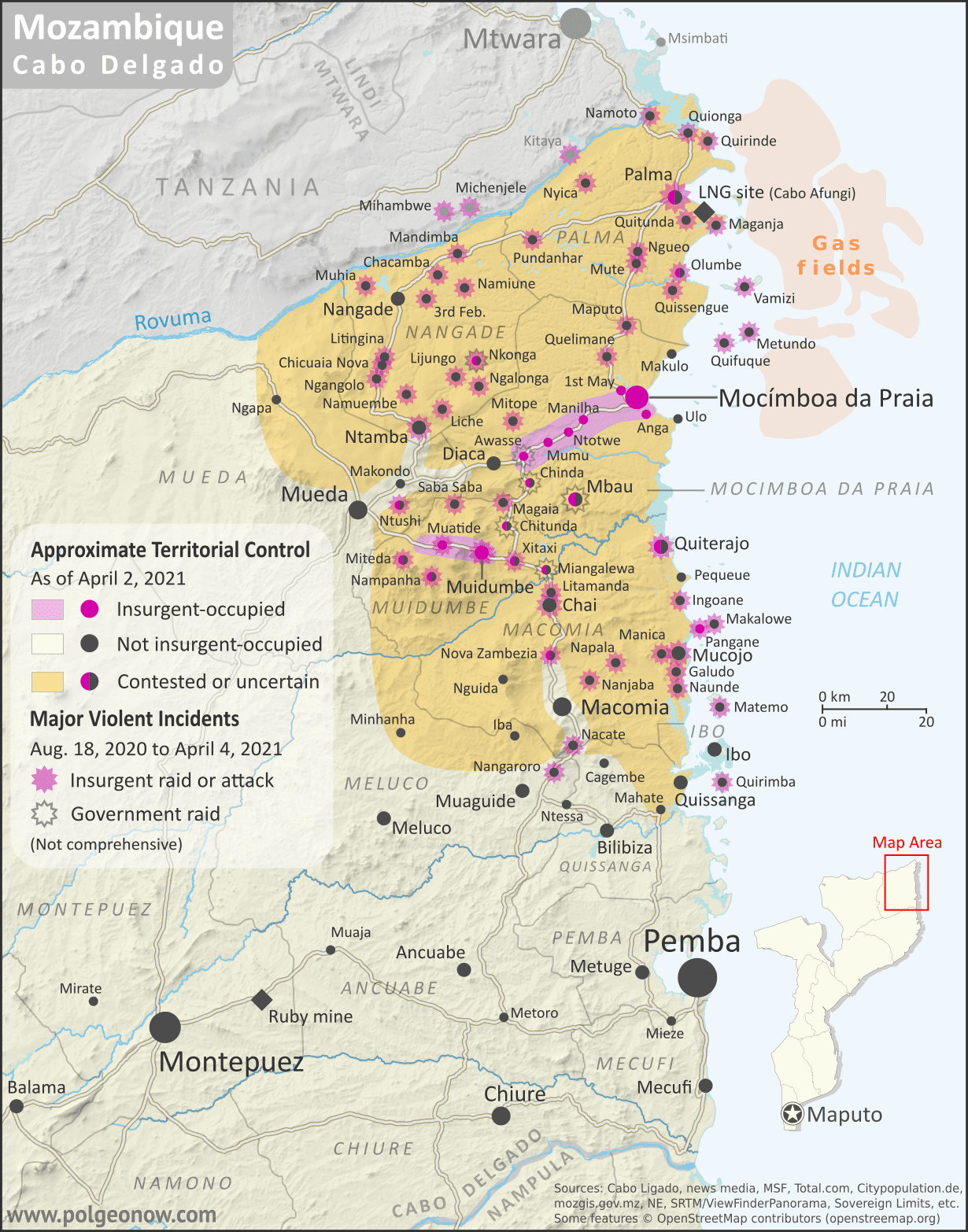
It's finally here: the close-up, super-detailed version of our Mozambique insurgency control map! This edition depicts the situation near the beginning of this month, when the government was fighting for control of Palma. A new close-up version of our August 2020 map is also now available, and future updates are expected more frequently from now on. To see the full list of reports, you can always view all Mozambique articles on PolGeoNow.

Mozambique: Cabo Delgado conflict map - April 2021: Detailed, close-up control map showing areas occupied by so-called ISIS-linked rebels in northern Mozambique (also known as Ahlu Sunnah Wa Jama, ASWJ, Ansar al-Sunnah, or Al Shabaab), plus towns and villages raided by the insurgents over the past eight months. Shows roads, rivers, and terrain, and includes key locations of the insurgency such as Palma, Mocímboa da Praia, Awasse, Macomia, the Total LNG site and natural gas fields, Muidumbe, Pangane, Muatide, Vamizi Island, and many more towns and villages. Key locations across the border in Tanzania also shown. Updated to April 2, 2021. Colorblind accessible.
Map by Evan Centanni and Djordje Djukic. Some elements © OpenStreetMap contributors. Terrain data sourced from ViewFinderPanoramas. Contact us for permission to use this map.

(Subscribers click here to view this article in the member area)

Timeline by Djordje Djukic and Evan Centanni

New: Close-up Cabo Delgado Insurgency Map

In the eight months since our first Mozambique conflict timeline was published, insurgents in Cabo Delgado province have gradually increased their control, continuing to raid villages and towns in multiple districts, culminating most recently in their temporary takeover of most of Palma, a major town close to under-construction natural gas facilities operated by French company Total. The rebel group - locally known as "Al Shabaab" but thought to formally label itself Ahlu Sunnah Wa-Jamâ (ASWJ) - is increasingly believed to be cooperating, if only loosely, with the so-called "Islamic State" (IS; ISIS/ISIL).

Now, for the first time, PolGeoNow presents our close-up map of the Cabo Delgado conflict, rigorously researched and edited to provide the most detailed, informative, and reliable map of insurgent control and attacks available anywhere.

2020年12月1日火曜日

Nagorno-Karabakh Control Map & Timeline: Artsakh Withdrawals - December 1, 2020

There are newer versions of this map available. To see them, view all Nagorno-Karabakh articles on PolGeoNow.
This update on the (approximate) final results of the 2020 Azerbaijan-Armenia war is free for all readers.

Nagorno-Karabakh control map, showing territorial claims and control after the Azerbaijan-Armenia war, including the self-proclaimed Republic of Artsakh. Updated to December 1, 2020, at the approximate time of completion of all Artsakh/Armenian withdrawals promised under the 2020 peace agreement. Colorblind accessible.
Map of current territorial control. By Evan Centanni and Djordje Djukic, starting from this map by
Bourrichon and Lesqual. License: CC BY-SA
 
 
Timeline by Djordje Djukic
 

Artsakh/Armenian Forces Make Promised Withdrawals

Map of territorial change in Nagorno-Karabakh before and after the 2020 war between Azerbaijan and the Armenia-backed, self-proclaimed Republic of Artsakh. Updated to December 1, 2020, the date of approximate completion of the Artsakh/Armenia withdrawals from areas outside the NKAO. Colorblind accessible.
Click to enlarge: Map of territorial changes during and after the war
(For credit and license see main map above)

Three weeks after the peace deal that brought an end to the 2020 war between Azerbaijan and the Armenia-backed, self-proclaimed Republic of Artsakh, the latter side has completed the additional withdrawals it promised in the deal.

Though no official map has yet been released of the new lines of control, PolGeoNow has estimated their course based on news reporting and a comparison between information reported by various other online mapping projects.

2020年9月29日火曜日

Ukraine War Control Map & Report: September 2020

To see other maps in this series, plus a new map of Russian control in the 2022 invasion, view all Ukraine articles on PolGeoNow.
Map of territorial control and frontlines in the Donbass region of Donetsk and Luhansk, internationally recognized as part of eastern Ukraine but partly controlled by the breakaway Donetsk People's Republic and Lugansk People's Republic. Updated for September 2020, with Minsk ceasefire lines shown. Colorblind accessible.
Map by Evan Centanni and Djordje Djukic. Contact us for permission to use this map.

(Subscribers click here to view this article in the member area)

Timeline by Djordje Djukic, with additional reporting by Evan Centanni

Donbass Frontline Map

In the four years since PolGeoNow last updated our Ukraine control map, little has changed in terms of territorial boundaries in the region of eastern Europe known as the Donbass. Forces of the Russia-backed self-proclaimed Donetsk People's Republic (DPR) and Lugansk People's Republic (LPR) still hold a large chunk of what most of the world considers Ukraine, though their plans of formally uniting into a confederation of "Novorossiya" ("New Russia") have long gone by the wayside. But as attempts at resolving the conflict peacefully grind slowly forward, fighting has continued at a low level along the frontlines, and we have made some small changes to the map where the situation has either changed or been clarified since 2016.

2020年8月17日月曜日

"Islamic State" in Mozambique? Control Map & Timeline of the Insurgency

There are newer editions of this map available. To see them, view all Mozambique articles on PolGeoNow.

This is the first edition of our new Mozambique control map series. To guarantee your access to future updates, sign up our conflict map subscription service (updates may be released for free if changes end up being very few or far between).

Mozambique Insurgency: Map of ISIS control in Mozambique, or of control by local insurgent group Ahlu Sunnah Wa-Jamâ / Ahlu Sunnah Wa-Jamaa / Ahlu Sunnah Wa-Jamaah (al-Sunna / al-Sunnah) in northern Mozambique's Cabo Delgado province, with territorial control, roads, rivers, and terrain. Includes key locations of the insurgency such as Mocímboa da Praia, Awasse, Macomia, Mucojo, Quissanga, Meluco, Muidumbe, Mueda, Mitumbate (Mutumbate), Palma, Pundanhar, and Nangade, as well as other important cities such as Pemba, Nampula, and Maputo. Neighboring countries shown, including Comoros, Madagascar, and French territories of Juan de Nova Island, Bassas da India, and Europa Island. Updated to August 17, 2020. Colorblind accessible.
Map by Evan Centanni and Djordje Djukic. Contact us for permission to use this map. Terrain data sourced from ViewFinderPanoramas.

(Subscribers click here to view this article in the member area)

Article by Evan Centanni and Djordje Djukic

Northern Mozambique's Insurgency: What We Do and Don't Know

Mozambique: Cabo Delgado insurgency map - October 2017 to August 2020: Detailed, close-up control map showing areas occupied by so-called ISIS-linked rebels in northern Mozambique (also known as Ahlu Sunnah Wa Jama, ASWJ, or Ansar al-Sunnah), plus towns and villages raided by the insurgents over the past three years. Shows roads, rivers, and terrain, and includes key locations of the insurgency such as Mocímboa da Praia, Awasse, Macomia, the Total LNG site and natural gas fields, Miangalewa, Litingina, Ntessa, Cagembe, Marere, Makulo, and many, many more. Colorblind accessible.
Close-up version of the above map, with expanded timeline (subscriber exclusive; click for more info).
International headlines broke last week describing a takeover of a northern Mozambique "city" by what many of them called the "Islamic State" (IS; formerly ISIS/ISIL). If this came as a complete surprise to you, you're not alone - even international analysts were startled when the insurgency began in 2017, and though the insurgents have actually overrun Mocímboa da Praia more than once since then, news coverage has been pretty limited.

At PolGeoNow, researcher Djordje Djukic has been keeping an eye on this conflict for some time, and we're now pleased to present what we believe to be the world's first map series documenting territorial control in the northern Mozambique insurgency. 

Update: A much more detailed close-up version of the above map, adding insurgent raids and accompanied by an expanded timeline, is now available to our paid subscribers.

2020年5月29日金曜日

Libyan Civil War Map & Timeline - May 2020

There are newer versions of this map available. To see them, view all Libya updates.

This is a free edition of our Libya control map series. If you want access to our full collection of Libya maps, you can sign up for our conflict map subscription service.

Libya: Who controls what? A concise, professional map of who controls Libya now (May 2020). Shows detailed territorial control in the Libyan Civil War as of May 29, 2020, including all major parties (Government of National Accord (GNA); Tobruk House of Representatives, General Haftar's Libyan National Army (LNA), and allies; Tuareg and Toubou (Tebu, Tubu) militias in the south; and the so-called Islamic State (ISIS/ISIL)). Includes terrain, major roads, and recent locations of interest including Al-Watiyah Airbase, Tarhuna, Mizda, and more. Colorblind accessible.
Base map by Koen Adams of onestopmap.com, with territorial control by Evan Centanni and Djordje Djukic.
Contact us for permission to use this map.

(Subscribers click here to view this article in the member area)

Timeline by Djordje Djukic, with additional reporting by Evan Centanni


Mapping Control in Libya as Proxy War Escalates

Since the time of our previous Libya control map report last month, the country's UN-recognized Government of National Accord (GNA) has continued to gain ground in the west amid a major withdrawal of the rival Libyan National Army (LNA). The GNA's gains have been achieved with extensive support from Turkey, in the form of thousands of Turkish-allied Syrian rebel fighters as well as many Turkish-provided drones, in what the UN has called "the largest drone war in the world". Meanwhile, the LNA now has its own allied Syrian fighting force, brought in to support Russian private military contractors (PMCs), who are widely claimed to have the full support of Russia's government.

2020年4月14日火曜日

Schengen Border Controls in the Time of Coronavirus (April 14, 2020)

This map and article have been updated to April 14, 2020. You can also view the previous edition of the map, from March 27, with its accompanying timeline.

Since 2016, PolGeoNow has mapped reinstated border controls within Europe's Schengen free travel area, with the companion piece to this article covering changes from mid-2017 up to last month. Now, border controls between European countries have drastically expanded amid the global coronavirus pandemic. 

Read on for a country-by-country list of border controls and travel bans, plus a timeline of what went into effect when.

Schengen borders map showing temporary reintroduction of border controls in the Schengen Area (the European Union's border-free travel zone) as of April 14, 2020, during the widespread closure of internal Schengen borders due to the COVID-19 coronavirus pandemic. Also includes, in a different color, controls announced by governments where the EU has not been notified.
Map by Evan Centanni, from blank map by Ssolbergj. License: CC BY-SA
Article by Evan Centanni

Coronavirus-related Border Checks in the Schengen Area

As many travelers know, much of Europe is linked together as part of the "Schengen Area", a collection of countries that don't make travelers show any ID to cross the borders between them, and don't regulate what people bring across with them either (although this system is overseen by the European Union, the Schengen Area and the EU aren't the same thing). But under special circumstances, member countries can choose to temporarily resume border checks (also known as "border control").